
Small accounting firms are in the middle of a major identity shift. What used to be defined by compliance delivery (bookkeeping, tax, year-end accounts) is increasingly defined by digital operations + advisory outcomes—faster closes, real-time visibility, automation, and proactive guidance.
In a digital-first era, “competitive” doesn’t mean having more software. It means building a repeatable, tech-enabled service model that clients experience as responsive, secure, and insight-driven. Firms like XMC Asia are well-positioned to help small practices operationalize this transformation—without losing quality, control, or profitability.
What’s Changing (and Why It Matters)

From periodic reporting to continuous visibility
Cloud accounting and connected apps have made it realistic for clients to expect near real-time financial updates, not end-of-month surprises. This pushes firms toward continuous close habits—clearing exceptions weekly, standardizing workflows, and reducing last-minute fire drills.

From manual processing to automation + AI assistance
Automation is no longer “nice to have.” Professional bodies and industry research increasingly frame automation as a practical lever for reducing busy-season strain and improving consistency in small firms.

From compliance-only to advisory-led relationships
Client Advisory Services (CAS) has become a growth engine across firms, with benchmarking programs explicitly tracking how firms structure, staff, and scale advisory offerings.
And industry reporting shows advisory is becoming more common as a way to meet evolving client expectations.

From “trust me” to measurable performance
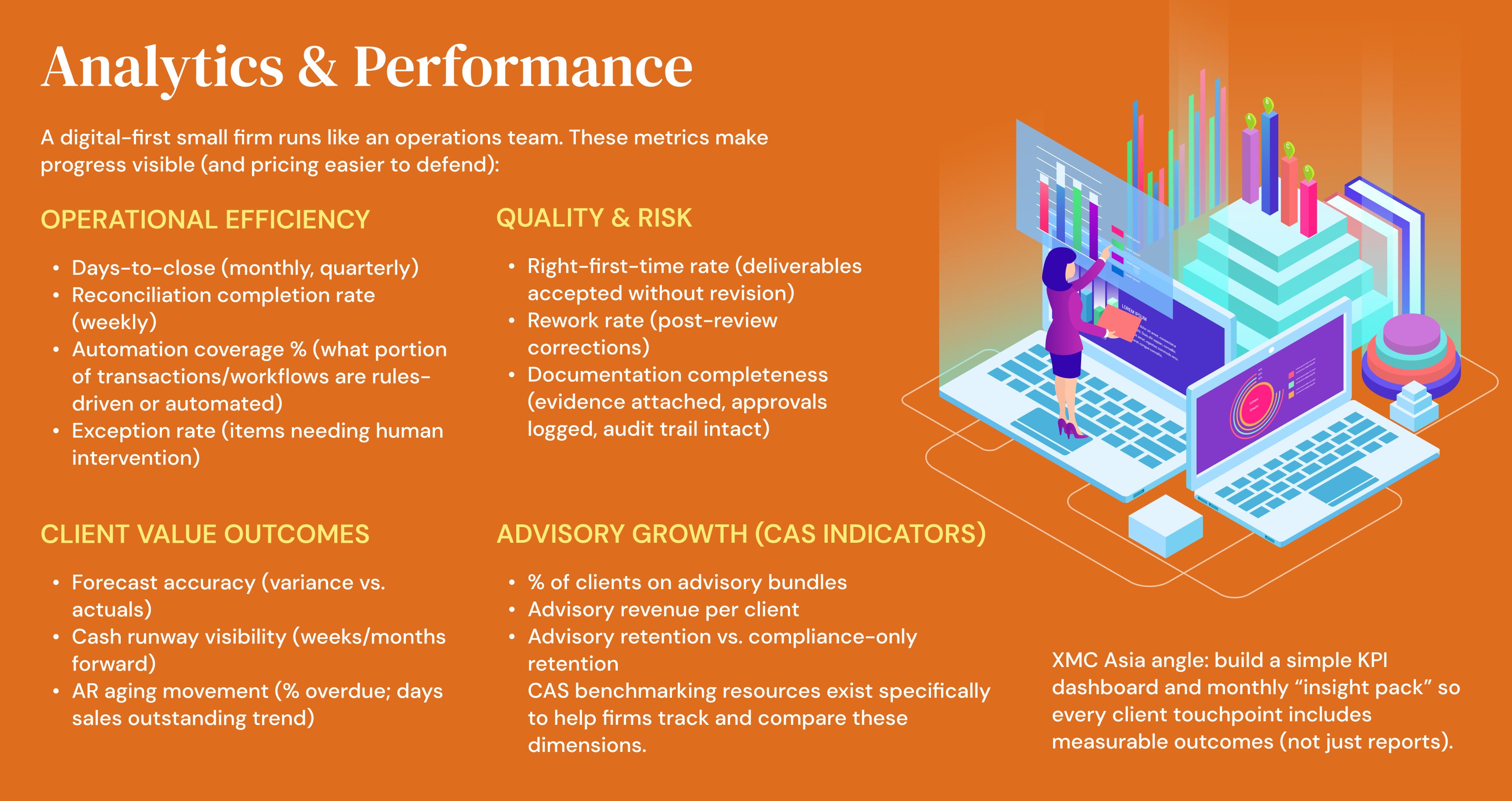
Clients want proof: shorter close cycles, cleaner books, better cash flow visibility, stronger forecasting. Digital-first firms differentiate by instrumenting performance (dashboards, SLAs, QA checks), not just promising better service.
Key Benefits
When small firms embrace digital-first operations, the benefits show up fast:
- Faster turnaround times through standardized workflows and automation (less manual back-and-forth, fewer bottlenecks).
- Higher margins by reducing low-value labor and reallocating time into advisory work.
- Better client retention because proactive insight (cash flow, forecasting, risk) creates stickier relationships—an outcome closely associated with CAS growth.
- Improved team experience with fewer chaotic closes and more predictable work cadence (a major small-firm talent advantage).
- Stronger security posture when processes are centralized, access-controlled, and documented (critical in a digital-first client experience).
Where XMC Asia fits: XMC Asia can support small firms by designing the operating model—workflow templates, client cadence, automation map, control points, and KPI reporting—so “digital-first” becomes a repeatable system, not a one-time project.

Conclusion
Small firm accounting is evolving from a document-driven profession into a digital operating system for clients’ financial decisions. The firms that win in the digital-first era will:
- standardize delivery,
- automate the repetitive,
- package advisory into repeatable offers, and
- prove value with metrics.
With the right operating blueprint, even small practices can deliver “big-firm” experience—without big-firm overhead. XMC Asia can help make that shift practical, controlled, and profitable.
References
- AICPA & CIMA (PCPS) — Technology resources: Transforming technology
- AICPA & CIMA — How to build automations in your small firm
- CPA.com — CAS Benchmark Survey
- CPA.com — 2024 CAS Benchmark Survey (PDF)
- Xero — Nearly three-quarters of US accountants and bookkeepers… State of the Industry report 2025 (press release)