
In 2026, outsourcing accounting isn’t just a cost play—it’s a speed + accuracy + insight strategy. Finance leaders are being asked to deliver faster closes, cleaner data, better forecasts, and real-time performance visibility, often without expanding headcount. That’s why more companies are leaning on specialized partners like XMC Asia to modernize core finance operations while keeping control over governance and decision-making.
The finance and accounting outsourcing market is also expanding quickly—reflecting how common this approach has become for growth-minded businesses.
Key Benefits

Faster close, stronger controls, fewer errors
Outsourced teams can standardize workflows (AP/AR, reconciliations, journal entries, month-end close) and reduce bottlenecks. The result is typically a shorter close cycle, more consistent documentation, and fewer “end-of-month surprises.”
What to look for:
- A documented close calendar (daily/weekly/monthly)
- Clear RACI (who does what, who approves)
Evidence of review controls (2-person checks, exception handling)

Access to scarce talent—without long hiring cycles
Accounting talent remains competitive, while finance roles increasingly require cross-skilling in systems, analytics, and automation. Many leaders are blending internal staff with outsourced specialists to cover gaps quickly—especially for close management, reporting, compliance support, and FP&A.
What to look for:
- Role coverage beyond bookkeeping (e.g., controller-level review, management reporting)
- Defined SLAs for turnaround times
- A plan for continuity (backup resources, documentation, knowledge transfer)

Tech-enabled finance without heavy internal buildout
The modern finance function is shifting toward automation + continuous/near-continuous close, with AI increasingly used for pattern detection, reconciliations, and reporting support. Many organizations outsource because they want the outcomes (speed, accuracy, insights) without building every capability in-house.
What to look for:
- Tool-stack compatibility (your accounting system + their workflow)
- Automation for high-volume work (bank recs, matching, variance flags)
- A clear data governance approach (chart of accounts hygiene, mapping rules)

Security and compliance maturity
Outsourcing only works if data protection is treated as non-negotiable. Providers increasingly highlight controls like SOC 2 or ISO 27001-aligned practices, role-based access, encryption, MFA, and audit trails.
What to look for:
- Written security policies + incident response process
- Access controls and permissioning standards
- Independent attestations/certifications where applicable

Better forecasting and decision support
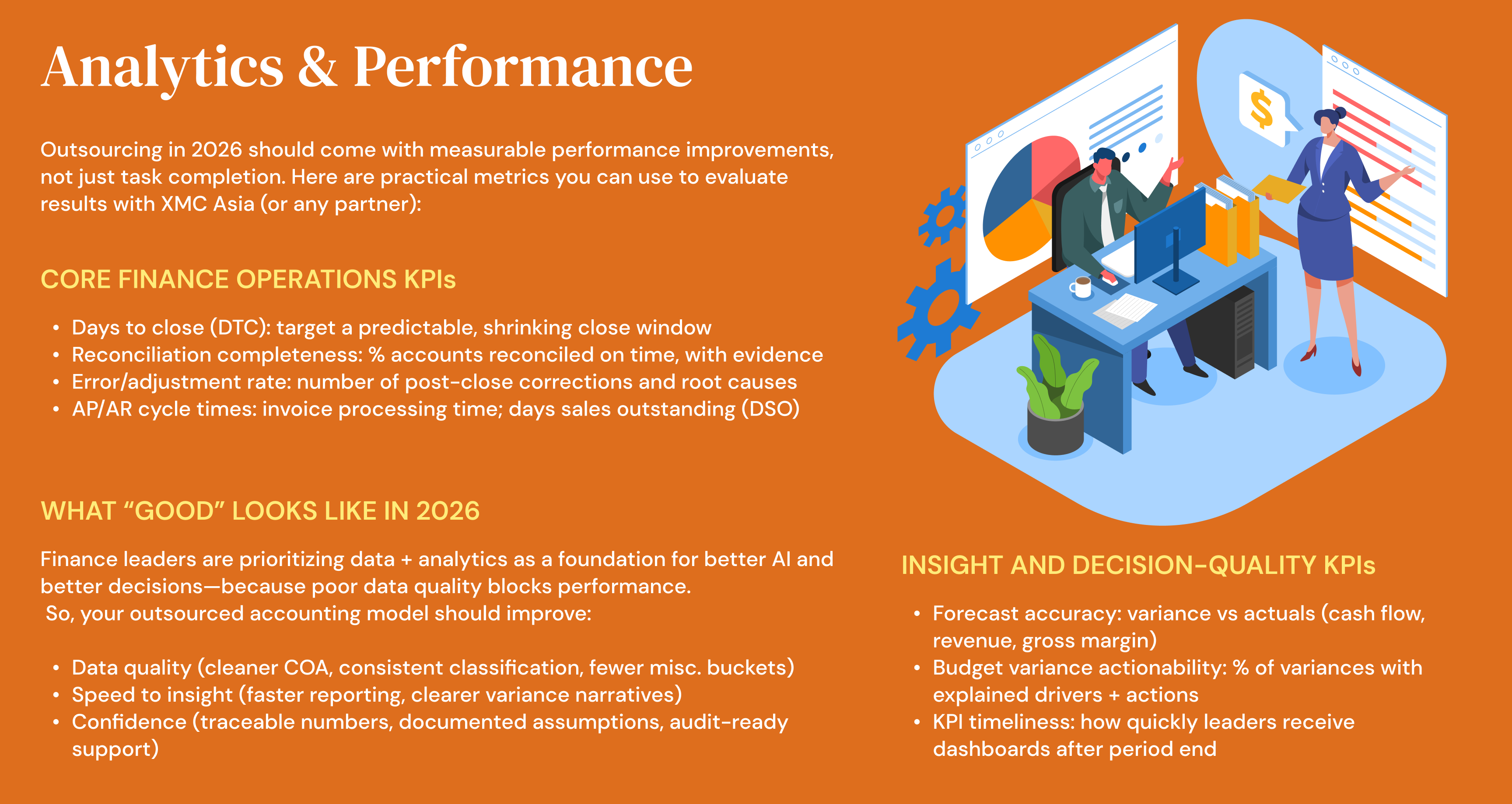
A major reason companies bring in partners like XMC Asia is to move from “reporting what happened” to guiding what to do next—through cash flow forecasting, margin analysis, scenario planning, and KPI dashboards.
What to look for:
- Forecast models tied to operational drivers (sales pipeline, churn, utilization, inventory turns)
- Management reporting cadence (weekly flash + monthly pack)
- A clear set of KPIs aligned to your goals (growth, profitability, efficiency, retention)

Conclusion
Businesses outsource accounting in 2026 because finance is now expected to be faster, more strategic, and more technology-enabled—without becoming bloated or brittle. The right partner doesn’t just “do the books.” They help you build a finance engine that produces reliable numbers, actionable insights, and scalable processes.
If you’re evaluating an outsourced model, prioritize partners like XMC Asia that can demonstrate:
- Operational discipline (SLAs, controls, documented workflows)
- Analytics maturity (forecasting, KPI design, variance intelligence)
- Security readiness (strong access controls and compliance hygiene)
- Scalability (coverage for growth, complexity, and system changes)
Done right, outsourced accounting becomes a competitive advantage—not a compromise.