
Disruption doesn’t announce itself politely. It shows up as a cyber incident, a regulatory shift, a talent squeeze, a client cash crunch, or a sudden market downturn—and it tests whether your firm is built on heroic effort or on resilient systems.
Future-proofing is less about predicting the next shock and more about building a firm that can absorb volatility, keep service quality stable, and pivot fast. This is where structured partners like XMC Asia can add real leverage—by helping you modernize operations, strengthen controls, and translate risk into measurable readiness.
Key Benefits

Operational resilience (service continuity even under stress)
A credible continuity model includes remote accessibility, reliable communication channels, and clearly defined response roles—so the firm doesn’t “go dark” when disruption hits.
Outcome: fewer missed deadlines, less client churn, stronger trust during crisis moments.

Stronger cybersecurity posture (because client data is your reputation)
Cyber risk is now a business risk. Framework-driven programs like the NIST Cybersecurity Framework (CSF) 2.0 provide a structured way to manage cyber risk and communicate controls.
Outcome: fewer incidents, faster recovery, and better client confidence in your handling of sensitive financial information.

Faster regulatory adaptation (sustainability, assurance, governance)
The compliance perimeter is expanding—especially around sustainability reporting and assurance readiness. IFAC’s guidance stresses building governance and control systems and improving connectivity between sustainability and financial reporting.
Outcome: you stay ahead of client questions, avoid last-minute scrambling, and open new advisory/assurance-adjacent work.

Better decision-making under uncertainty
Firms that can quickly produce scenario-based views (cash flow, staffing, pipeline risk) are better positioned to protect margins and keep delivery stable.
Outcome: fewer “reactionary discounts,” cleaner resource planning, more predictable performance.

A scalable operating model (less heroics, more repeatable delivery)
Disruptions expose weak processes. Standardized workflows, clear ownership, and documented controls reduce dependency on a few key people.
Outcome: easier delegation, smoother onboarding, and less operational fragility.
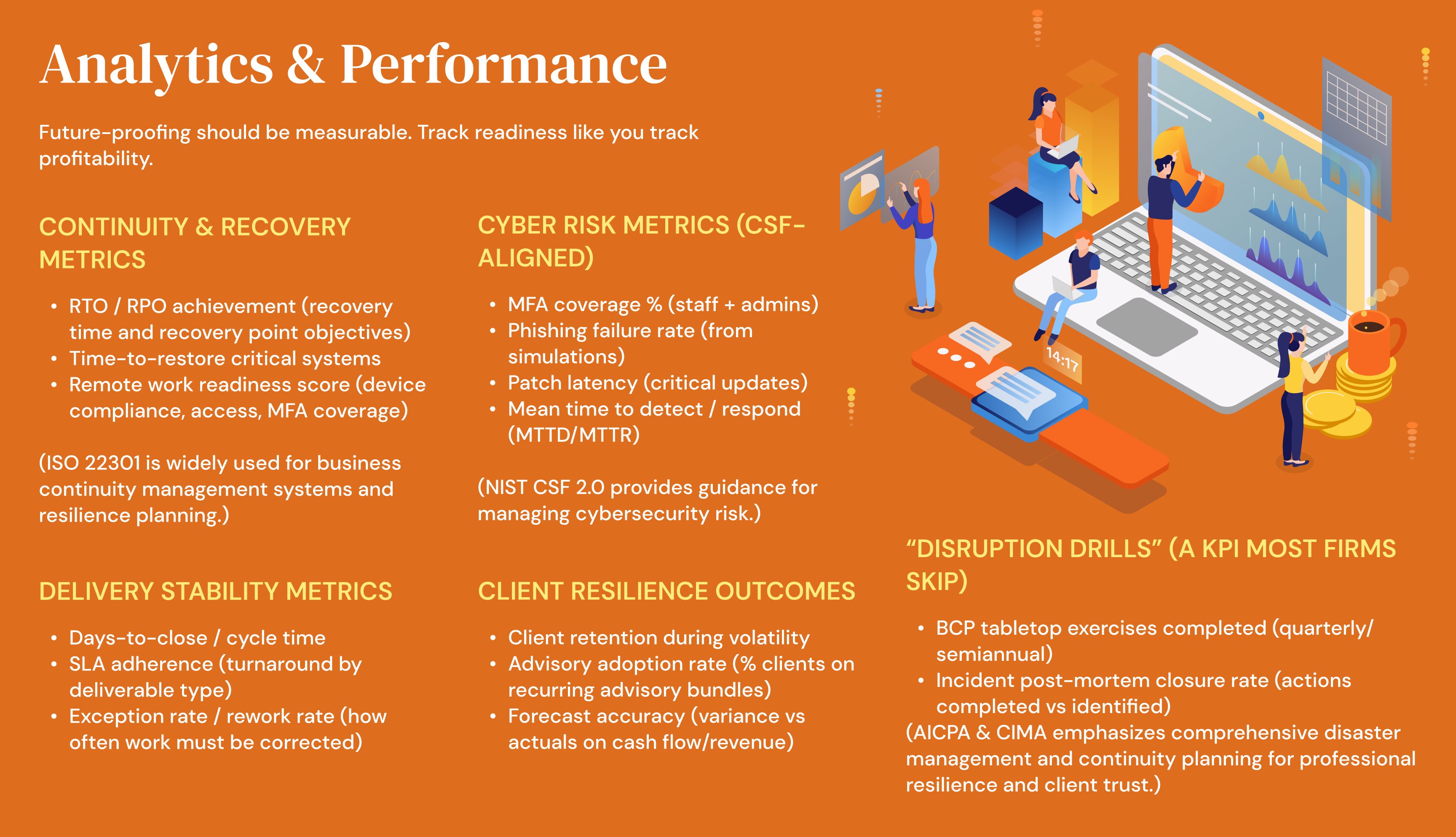
Where XMC Asia fits: XMC Asia can help you move from “best effort resilience” to a repeatable resilience system—BCP/DR playbooks, risk and control design, process standardization, and KPI dashboards that show readiness in real time.

Conclusion
The next disruption will reward firms that are operationally disciplined, cyber-aware, and governance-ready—not just technically competent. Future-proof firms don’t simply “survive” volatility; they use it to differentiate through stable delivery, faster decision-making, and deeper client trust.
If your goal is to build that kind of resilience, XMC Asia can help you formalize business continuity, strengthen controls, modernize workflows, and implement performance tracking—so readiness becomes a measurable capability, not a hope.
References
- AICPA & CIMA — Disaster management essentials for CPAs
- AICPA & CIMA — Business continuity management is a must. Here’s a framework.
- NIST — The NIST Cybersecurity Framework (CSF) 2.0 (PDF)
- NIST — Cybersecurity Framework (CSF) program page
- ISO — ISO 22301:2019 Business continuity management systems
- IFAC — Building trust in sustainability reporting and preparing for assurance (Guidance)