
By 2026, “good accounting” isn’t just technical accuracy—it’s technology fluency, data-driven judgment, and client-ready communication. Industry bodies are already signaling the same direction: demand is rising for AI capability, data analytics, cybersecurity awareness, and sustainability/ESG competence, alongside the human skills that make insight actionable.
Below is a practical skills roadmap that small and mid-sized firms can use to upskill teams fast—without turning training into an endless project.
Skills That Matter Most by 2026

AI literacy (and safe use in real workflows)
Not everyone needs to “build models,” but accountants increasingly need to use AI responsibly: drafting narratives, summarizing support, spotting anomalies, accelerating reconciliations, and improving client response time—while understanding limitations and review requirements. AICPA/CIMA survey findings highlight generative AI as a major skills gap for finance teams.
Practical competencies
- Prompting for accounting outputs (memos, variance narratives, control checklists)
- Verification habits (source-checking, tie-outs, audit trail discipline)
- AI governance basics (what is allowed, what must be reviewed, what must be documented)

Data analytics (turning transactions into decisions)
Data fluency is no longer “nice to have.” Accountants are expected to interpret trends, build simple models, and explain drivers clearly—especially in advisory-led engagements. ICAEW’s 2026 skills list explicitly calls out data and analytics as in-demand.
Practical competencies
- KPI design (what to measure and why)
- Variance decomposition (price/volume/mix, cost drivers)
- Dashboard fluency (interpretation > decoration)

Cybersecurity and data privacy awareness
Accountants handle highly sensitive financial and identity data; cyber hygiene is now a core professional competency. ICAEW lists cybersecurity among key in-demand areas for 2026.
Practical competencies
- Access controls and least-privilege thinking
- Secure document exchange habits
- Recognizing phishing/social engineering patterns

Sustainability / ESG reporting readiness
Sustainability reporting and assurance readiness is increasingly shaping the profession’s education standards and services. IFAC has updated international education standards to embed sustainability throughout professional training.
Practical competencies
- Understanding ESG data types and control requirements
- Evidence/documentation discipline for non-financial metrics
- Connecting sustainability reporting with financial impacts and risk

Advisory mindset (commercial judgment + scenario thinking)
Clients expect accountants to move beyond compliance into planning and decision support—cash flow, pricing, cost control, and growth tradeoffs. This requires strong business judgment and the ability to frame options.
Practical competencies
- Scenario planning (best/base/worst case)
- Cash conversion levers (AR/AP/inventory drivers)
- Translating accounting signals into operational actions

Communication and data storytelling
As AI and automation expand, “human skills” become more differentiating—especially the ability to explain uncertainty, tradeoffs, and implications. The World Economic Forum’s Future of Jobs work consistently places skills like analytical thinking and leadership/social influence among those rising in importance.
Practical competencies
- Writing executive-ready summaries (“so what / now what”)
- Presenting insights to non-finance stakeholders
- Asking better questions in client calls
Key Benefits
Upskilling around these areas creates immediate competitive advantages:
- Faster delivery and better margins through automation + AI-assisted workflows (with clear review discipline).
- Higher-value client relationships as teams shift from “reporting history” to “guiding decisions” with analytics and scenario insights.
- Reduced risk exposure by strengthening cybersecurity awareness and governance around data handling.
- New service lines as sustainability/ESG readiness becomes a larger part of reporting and assurance expectations.
- Stronger trust and retention because clients feel the firm is proactive, not reactive.
(If you’re positioning a brand like XMC Asia, these benefits translate cleanly into service-page language: “faster close,” “better forecasting,” “stronger controls,” “ESG readiness,” and “AI-enabled productivity.”)
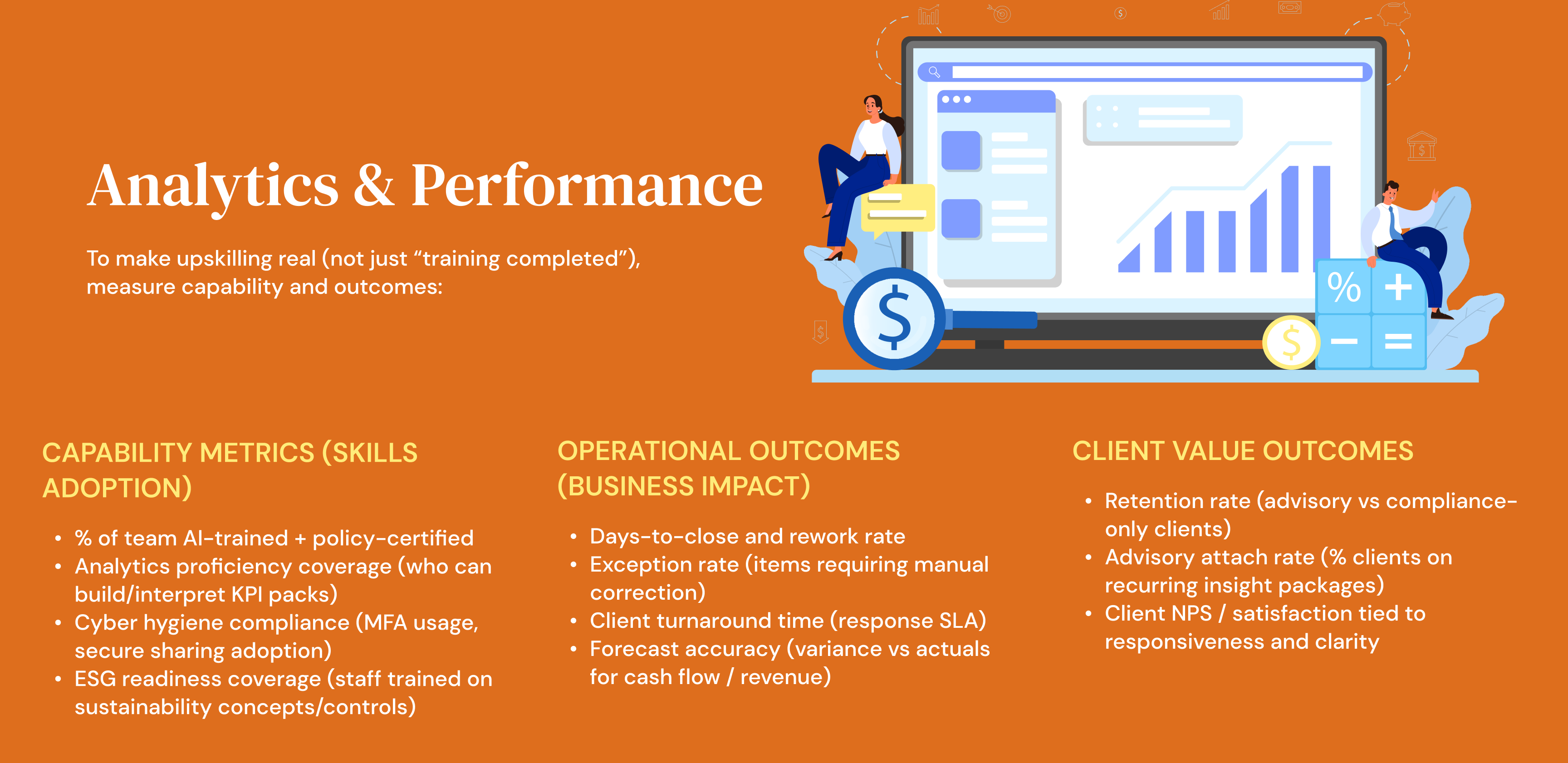
Conclusion
By 2026, the accountants who stand out won’t be the ones who simply “know the rules.” They’ll be the ones who can use AI safely, interpret data confidently, protect information, understand sustainability expectations, and communicate insights clearly. The upside is huge: stronger margins, higher client trust, and services that scale.
If you want, I can turn this into your usual blog format with SEO keywords + meta description, and (if needed) naturally insert XMC Asia in the intro/mid/conclusion for brand search visibility.
References
- AICPA & CIMA — Future-ready finance: Technology, Productivity, and Skills (survey)
- AICPA & CIMA — AI transformation opens door for finance professionals to build future-ready skills
- IFAC — IFAC enhances International Education Standards to embed sustainability
- World Economic Forum — The Future of Jobs Report 2025 (PDF)
- World Economic Forum — Future of Jobs Report 2025: skills you need