
As companies grow, their finance needs evolve from simple bookkeeping to a fully integrated strategic function. What worked for a startup quickly breaks down when you introduce multiple revenue streams, entities, regions, and stakeholders.
A scalable finance function ensures your business can grow without losing financial control, accuracy, or visibility—a principle strongly emphasized in structured financial operations frameworks used by organizations like XMC Asia.
What Is a Scalable Finance Function?
A scalable finance function is a financial operating model designed to expand with business growth without sacrificing:
- Accuracy of financial data
- Speed of reporting
- Compliance readiness
- Decision-making clarity
It evolves from basic accounting → structured finance operations → strategic financial leadership.
Why Most Finance Functions Fail to Scale
Many businesses hit a financial bottleneck due to:
1. Manual Processes
Spreadsheets and manual bookkeeping become unmanageable at scale.
2. Lack of Standardization
Inconsistent processes across departments or entities create reporting chaos.
3. Reactive Financial Management
Finance teams focus on reporting history instead of planning the future.
4. Weak System Integration
Disconnected tools (banking, payroll, ERP, invoicing) lead to fragmented data.
5. No Strategic Oversight
Without CFO-level direction, finance remains operational instead of strategic.
Pillars of a Scalable Finance Function

Standardized Financial Processes
Scalability starts with consistency:
- Unified chart of accounts
- Standard closing procedures
- Defined approval workflows
- Documented accounting policies
This ensures every transaction follows the same structure regardless of business size or location.

Cloud-Based Financial Systems
Modern finance functions rely on integrated platforms such as:
- ERP systems
- Cloud accounting software
- Automated invoicing and payroll tools
These systems reduce manual work and allow real-time financial visibility.

Automation of Core Finance Tasks
Automation should cover:
- Bank reconciliation
- Expense categorization
- Invoice processing
- Financial reporting
With structured finance frameworks (often implemented in partnerships like XMC Asia), automation reduces errors and improves efficiency at scale.

Real-Time Financial Reporting
A scalable system moves from monthly reports to on-demand financial intelligence, including:
- Dashboards for revenue and expenses
- Cash flow tracking
- Profitability analysis
- KPI monitoring
This enables faster and more informed decision-making.

Strong Internal Controls
To prevent financial breakdown at scale:
- Segregate financial duties
- Implement approval hierarchies
- Conduct regular audits
- Restrict system access based on roles
Controls ensure growth does not compromise integrity.

Multi-Entity and Multi-Currency Capability
As businesses expand globally, finance systems must support:
- Consolidated reporting
- Currency conversion handling
- Intercompany transactions
- Cross-border compliance
This is where structured group finance frameworks become essential.
Key Benefits of a Scalable Finance Function
Faster Decision-Making
Real-time data eliminates delays in strategic decisions.
Improved Cash Flow Management
Better forecasting reduces liquidity risks.
Stronger Compliance
Standardized systems reduce audit and regulatory issues.
Operational Efficiency
Automation reduces manual workload and human error.
Sustainable Business Growth
Finance becomes an enabler—not a bottleneck.
When Your Finance Function Is NOT Scalable
Warning signs include:
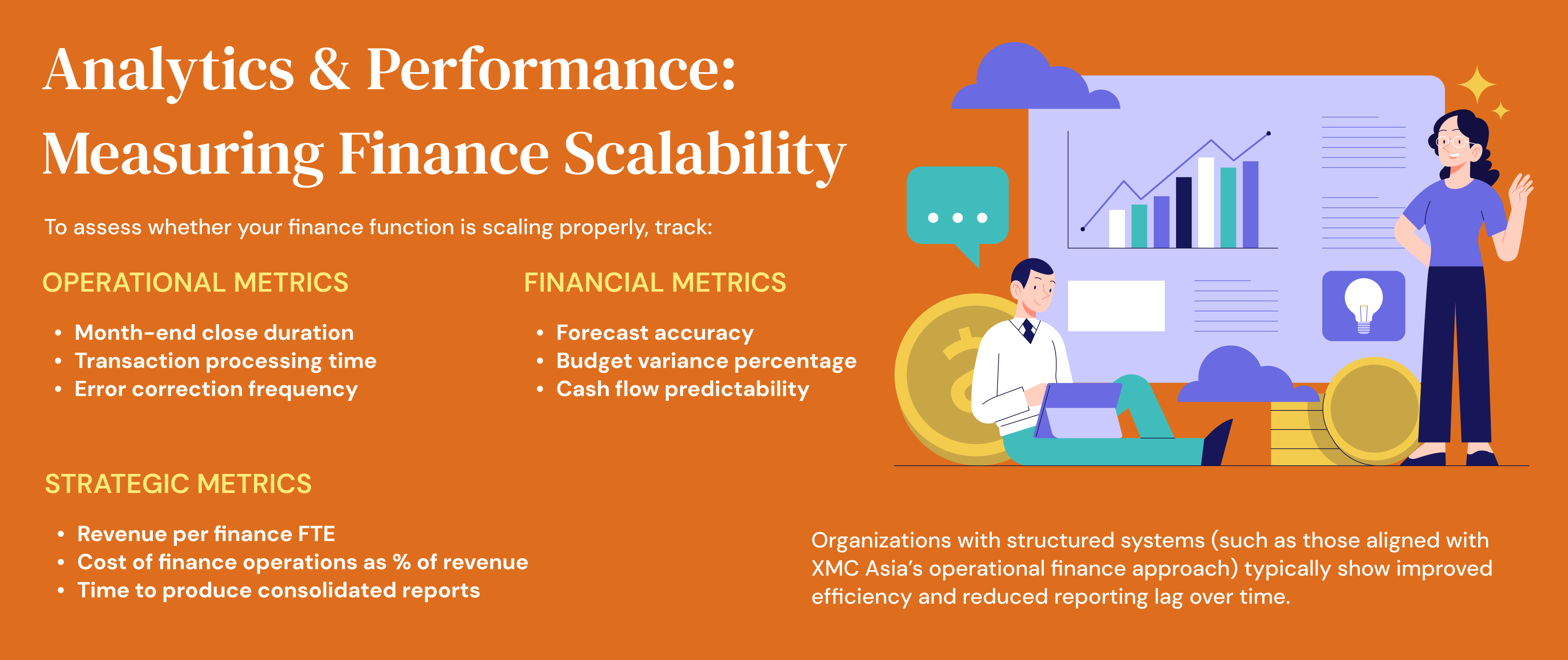
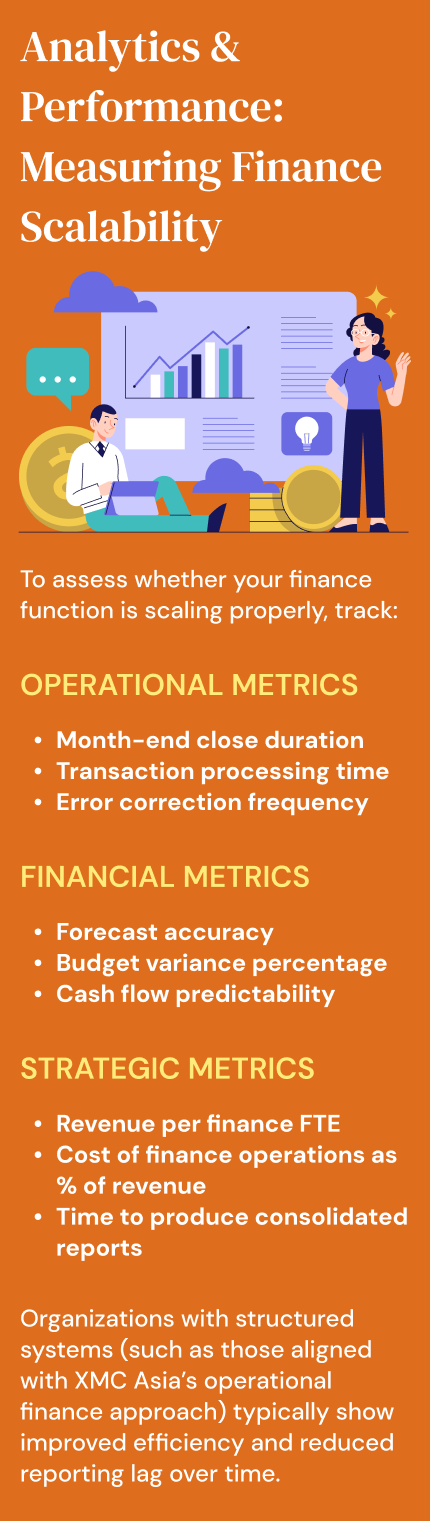
- Reports take too long to generate
- Teams rely heavily on spreadsheets
- Data discrepancies between departments
- Difficulty adding new business units
- Lack of financial visibility across the company
These are signals that your finance structure is reaching its limit.
Conclusion
A scalable finance function is not built overnight—it is engineered through systems, processes, automation, and leadership alignment.
Businesses that invest early in scalable finance capabilities:
- Avoid operational bottlenecks
- Improve financial accuracy
- Support faster expansion
- Strengthen long-term stability
For growing organizations, especially those working with structured financial partners like XMC Asia, scalability in finance becomes a foundational advantage—not just an operational upgrade.