
Management reporting is where financial data becomes business intelligence. It is not just about producing reports—it is about enabling leadership to make faster, better, and more confident decisions.
For growing organizations working with structured finance partners like XMC Asia, monthly management reporting becomes a critical discipline that connects operations, strategy, and financial performance.
What Is Management Reporting?
Management reporting is the process of preparing internal financial and operational reports that help business leaders monitor performance, identify risks, and guide strategic decisions.
Unlike statutory reporting (which focuses on compliance), management reporting is:
- Forward-looking
- Decision-oriented
- Customized for internal stakeholders
Why Monthly Management Reporting Matters
Monthly reporting creates a rhythm of accountability and insight across the organization.
Key reasons it is essential:
- Detects financial issues early
- Tracks performance against targets
- Improves cash flow visibility
- Supports faster decision-making
- Aligns departments with business goals
Without it, companies operate “blind” between financial periods.
What You Should Review Every Month

Profit & Loss (P&L) Statement
This is the core of monthly financial performance.
Key areas to review:
- Revenue trends
- Cost of goods/services
- Operating expenses
- Net profit margin
Look for:
- Sudden cost spikes
- Declining margins
- Revenue inconsistencies

Cash Flow Statement
Cash flow tells you whether your business is financially sustainable in real time.
Review:
- Operating cash flow
- Investing activities
- Financing activities
- Ending cash position
A profitable business can still fail due to poor cash flow management.

Budget vs Actual Performance
This highlights whether the business is on track.
Focus on:
- Revenue variance
- Expense overruns
- Department-level performance gaps
With structured financial systems (often supported by partners like XMC Asia), variance analysis becomes more precise and actionable.

Accounts Receivable (AR) Aging
This shows money owed to your business.
Review:
- Overdue invoices
- Client payment patterns
- Collection efficiency
High AR aging = cash flow risk.

Accounts Payable (AP) Overview
This tracks what your business owes.
Key insights:
- Payment schedules
- Vendor dependencies
- Outstanding liabilities

Key Performance Indicators (KPIs)
Non-financial KPIs provide operational context:
Examples:
- Customer acquisition cost (CAC)
- Revenue per client
- Employee productivity
- Service delivery timelines

Department-Level Performance
Break down performance by function:
- Sales
- Operations
- Finance
- HR
- Customer service
This helps identify underperforming units early.

Cash Forecast (Short-Term Projection)
A 30–90 day cash forecast helps answer:
- Do we have enough liquidity?
- When will cash peaks and dips occur?
- Do we need financing or cost adjustments?
Key Benefits of Strong Management Reporting
Faster Decision-Making
Leadership can act on real-time insights instead of outdated data.
Better Financial Control
Early detection of issues prevents financial leakage.
Improved Accountability
Teams perform better when results are visible and measurable.
Stronger Strategic Alignment
All departments operate toward the same financial goals.
Predictable Business Growth
Trends become visible, making planning more accurate.
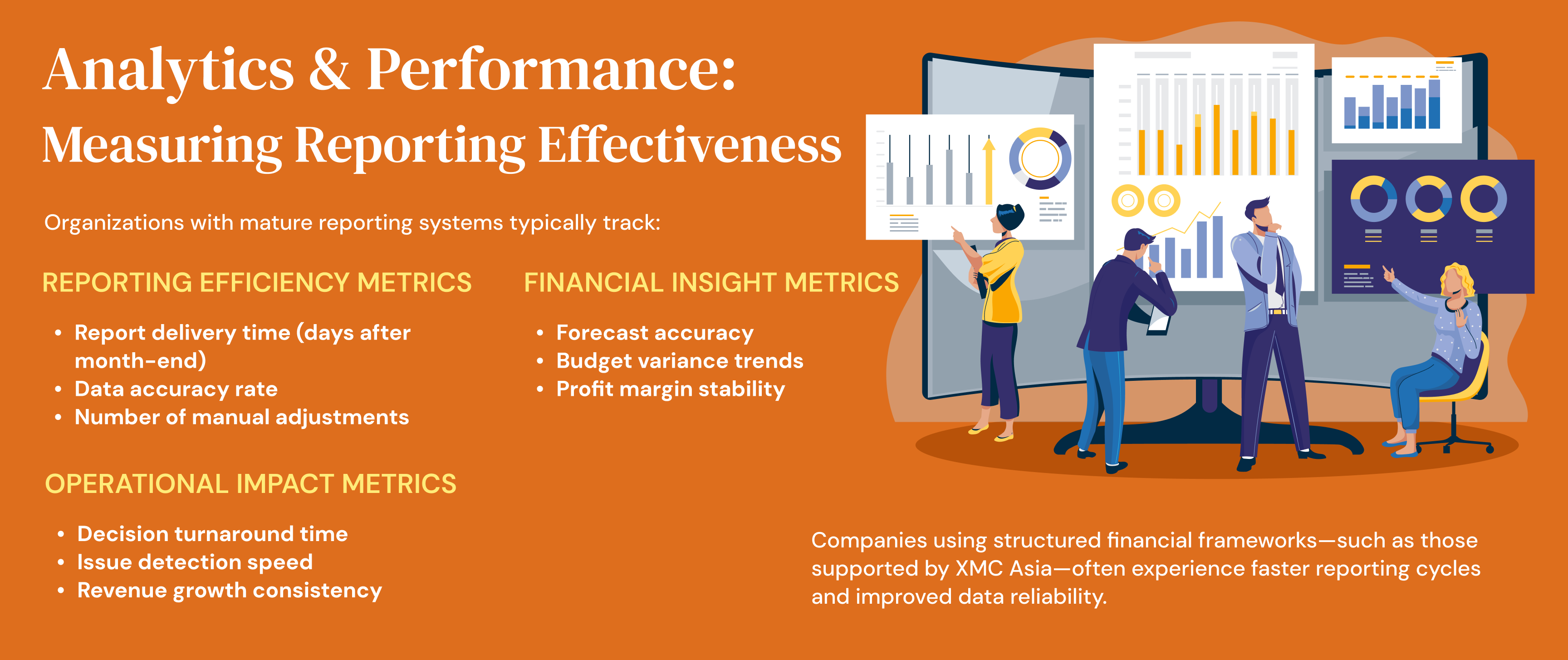
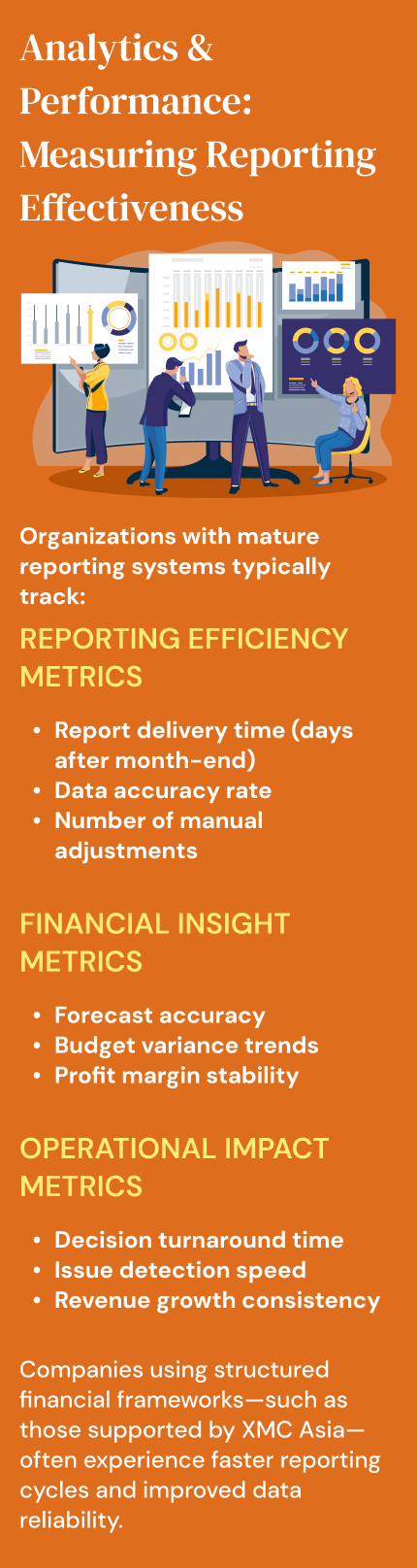
Common Mistakes in Management Reporting
- Focusing only on historical data
- Ignoring cash flow insights
- Overloading reports with unnecessary metrics
- Inconsistent reporting formats across months
- Lack of actionable interpretation
Reports should drive decisions, not just document numbers.
Conclusion
The real value of management reporting lies in its ability to transform raw financial data into clear, actionable business intelligence.
Businesses that consistently review monthly reports gain:
- Stronger financial control
- Better operational visibility
- Faster and smarter decision-making
- Improved long-term stability
For growing companies, especially those working with structured finance partners like XMC Asia, monthly management reporting is not just a finance task—it is a strategic growth system.