
Global expansion is rarely limited by ambition—it’s limited by execution risk: tax exposure, entity setup, cash control, cross-border compliance, and reporting complexity. Accountants don’t just “close the books” in this phase; they become the operating layer that helps leadership scale without losing control.
For growth-minded teams, XMC Asia can support international expansion by designing the financial, tax, and reporting infrastructure that keeps new markets compliant, bankable, and predictable.
Key Benefits

Market-entry readiness (entity, tax, and compliance)
Accountants help clients choose the right market-entry structure—subsidiary, branch, representative office, distributor model—then align:
- local registration and statutory filings
- tax registrations (VAT/GST, payroll taxes, withholding)
- policy frameworks (expense controls, approvals, documentation)
This reduces rework and prevents early mistakes that become costly once the business scales.

Transfer pricing + cross-border risk control
As soon as a company has multiple entities, intercompany activity becomes the norm: management fees, IP charges, shared services, cost allocations, intercompany loans.
Accountants help clients implement transfer pricing policies that are defensible and well-documented, aligned with OECD guidance.
This is where XMC Asia can add high-value support: building the documentation, setting pricing methodologies, and creating the audit trail that makes the story consistent.

Global tax strategy (including minimum tax readiness)
International growth can trigger exposure to new tax rules and reporting obligations—especially for larger groups approaching thresholds impacted by global minimum tax frameworks (Pillar Two / GloBE).
Accountants help clients:
- evaluate “effective tax rate” outcomes by jurisdiction
- map data requirements early (before audits or filings)
- plan entity and profit allocation with fewer surprises

Multi-currency accounting + clean consolidation
Expansion adds foreign currency transactions, functional currency decisions, remeasurement, and translation impacts. IAS 21 defines core principles for handling foreign exchange effects and functional currency determination.
A good accounting partner ensures:
- consistent FX rate sources and policies
- clean consolidation workflows
- reliable reporting for management and investors

Scalable revenue recognition + contract discipline
Cross-border contracts often introduce new revenue complexities: multi-element services, variable consideration, delivery/acceptance terms, and differing commercial practices. IFRS 15 provides the core recognition model many multinational groups rely on.
Accountants help standardize contract templates and data capture so revenue reporting stays consistent as countries and customer types expand.

Conclusion
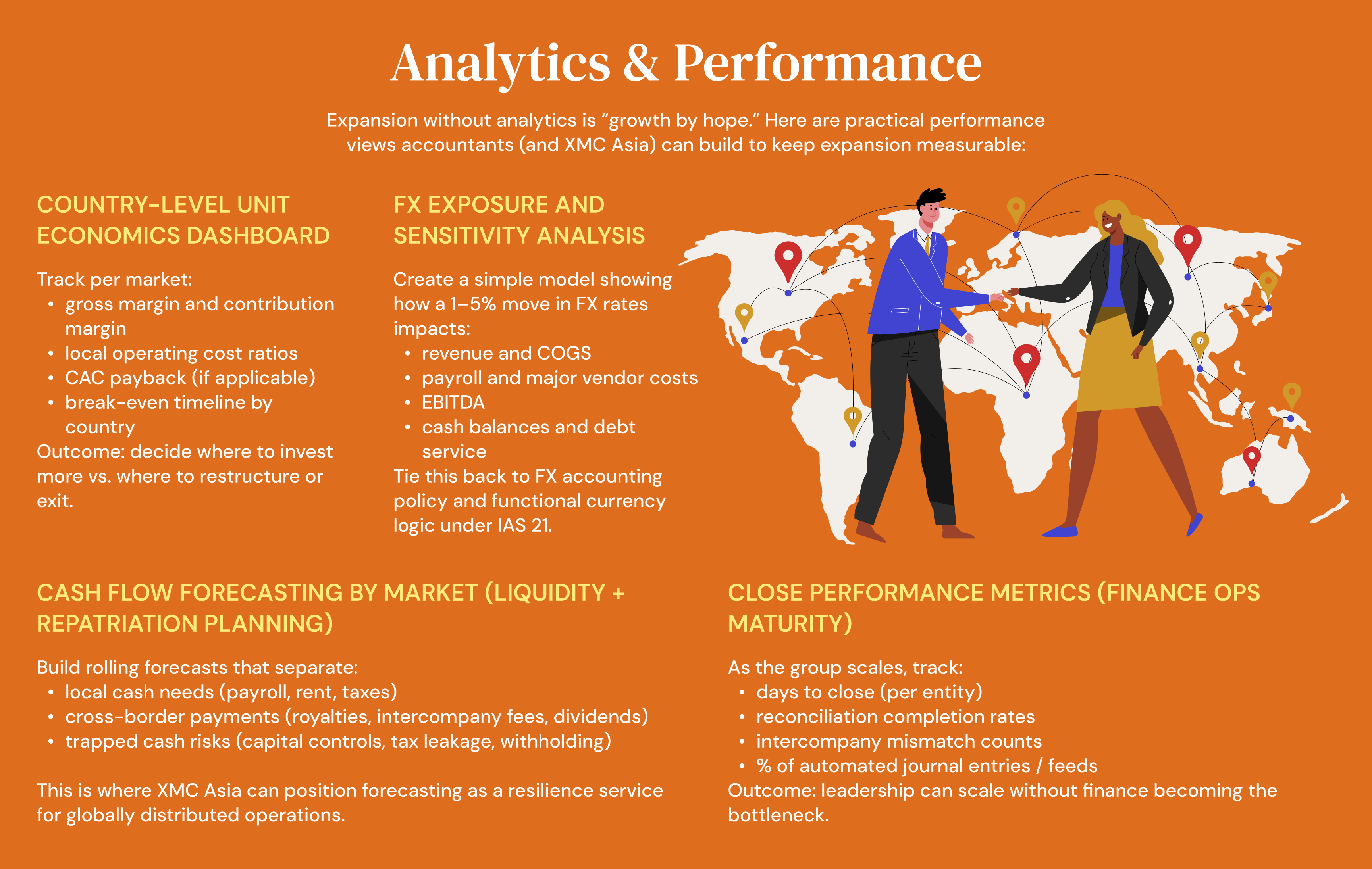
International growth multiplies complexity—tax rules, currencies, entities, contracts, and reporting standards. Accountants reduce that complexity into a controlled system: compliant structures, defensible intercompany policies, consistent reporting, and analytics that tell leaders what’s working.
With the right frameworks in place, firms like XMC Asia help clients expand confidently—protecting margins, preserving cash visibility, and keeping every new market “board-ready” from day one.
References
- OECD — Transfer Pricing Guidelines for Multinational Enterprises and Tax Administrations (2022)
- IFRS — IAS 21: The Effects of Changes in Foreign Exchange Rates
- IFRS — IFRS 15: Revenue from Contracts with Customers
- OECD — Global Anti-Base Erosion (GloBE) Model Rules (Pillar Two)
- OECD — GloBE Model Rules (Pillar Two) PDF (2021)