
In an increasingly regulated business environment, companies can no longer wait until year‑end to think about compliance and audits. Keeping clients audit‑ready is now a continuous process — one that blends proactive systems, real‑time reporting, and smart processes. Accounting professionals must help clients stay compliant with standards, reduce risk, and be ready for audits at any time. Leveraging technology, structured workflows, and expert support — including solutions from XMC Asia — can make this complex task simpler, smarter, and more efficient.
In this blog, we’ll explore why audit readiness matters, share analytics and important statistics, outline modern compliance best practices, highlight the key benefits, and conclude with strategic insights for accounting teams and business owners.

What Does “Audit‑Ready” Really Mean?
An audit‑ready organization is one that:
✔ Maintains accurate, up‑to‑date accounting records
✔ Has standardized policies and internal controls
✔ Produces transparent and traceable documentation
✔ Uses technology to minimize errors and enhance visibility
These capabilities reduce stress during audits, speed up audit schedules, and minimize unexpected issues or penalties.
Modern Compliance Best Practices

Continuous Record Maintenance
Instead of waiting for year‑end, financial records should be updated in real time:
- Daily reconciliations of bank and ledger items
- Weekly review of expense classifications
- Monthly closing checklists that ensure completeness
This prevents the backlog of unresolved items and reduces last‑minute pressure.

Standardize Documentation & Policies
Clear policies around:
- Expense approval
- Revenue recognition
- Capitalization vs. expense classification
- Segregation of duties
Having standard operating procedures (SOPs) ensures consistency and clarity for auditors.

Automate Controls Where Possible
Automation tools can verify compliance in real time:
- Flag unusual transactions
- Enforce approval hierarchies
- Generate audit trails with timestamps
Companies using automation report up to 40% fewer errors in routine financial controls.

Leverage Technology Platforms
Platforms like XMC Asia help accounting firms and clients by providing:
- Cloud‑based financial systems
- Secure documentation repositories
- Real‑time reporting dashboards
- Automated controls testing
This reduces manual effort, increases reliability, and ensures documentation is consistently audit‑ready.

Conduct Internal Compliance Reviews
Quarterly mock audits help identify gaps ahead of external auditors. These internal checks raise compliance scores and reduce surprises at official audit time.

Train Staff Regularly
Compliance expectations change, and teams need continuous education on:
- Regulatory updates
- Reporting standards
- Internal control requirements
Training reduces errors and boosts confidence during audits.
Role of XMC Asia in Audit Readiness
XMC Asia is positioned to support firms and clients with compliance excellence. Here’s how:
🔹 Real‑Time Visibility: Cloud dashboards show up‑to‑the‑minute financials
🔹 Automated Workflows: Documentation and control checks happen continuously
🔹 Centralized Storage: All records stay organized and easily retrievable
🔹 Compliance Tools: Built‑in compliance checks reduce manual risk
🔹 Expert Support: Guidance for firms and teams on best practices
By integrating XMC Asia’s tools with standard procedures, firms can ensure clients are not only compliant today — but audit‑ready every day.
Key Benefits of Being Audit‑Ready
Reduced Audit Costs
Less time spent gathering documents and fixing errors means lower audit fees and faster turnaround.
Lower Compliance Risk
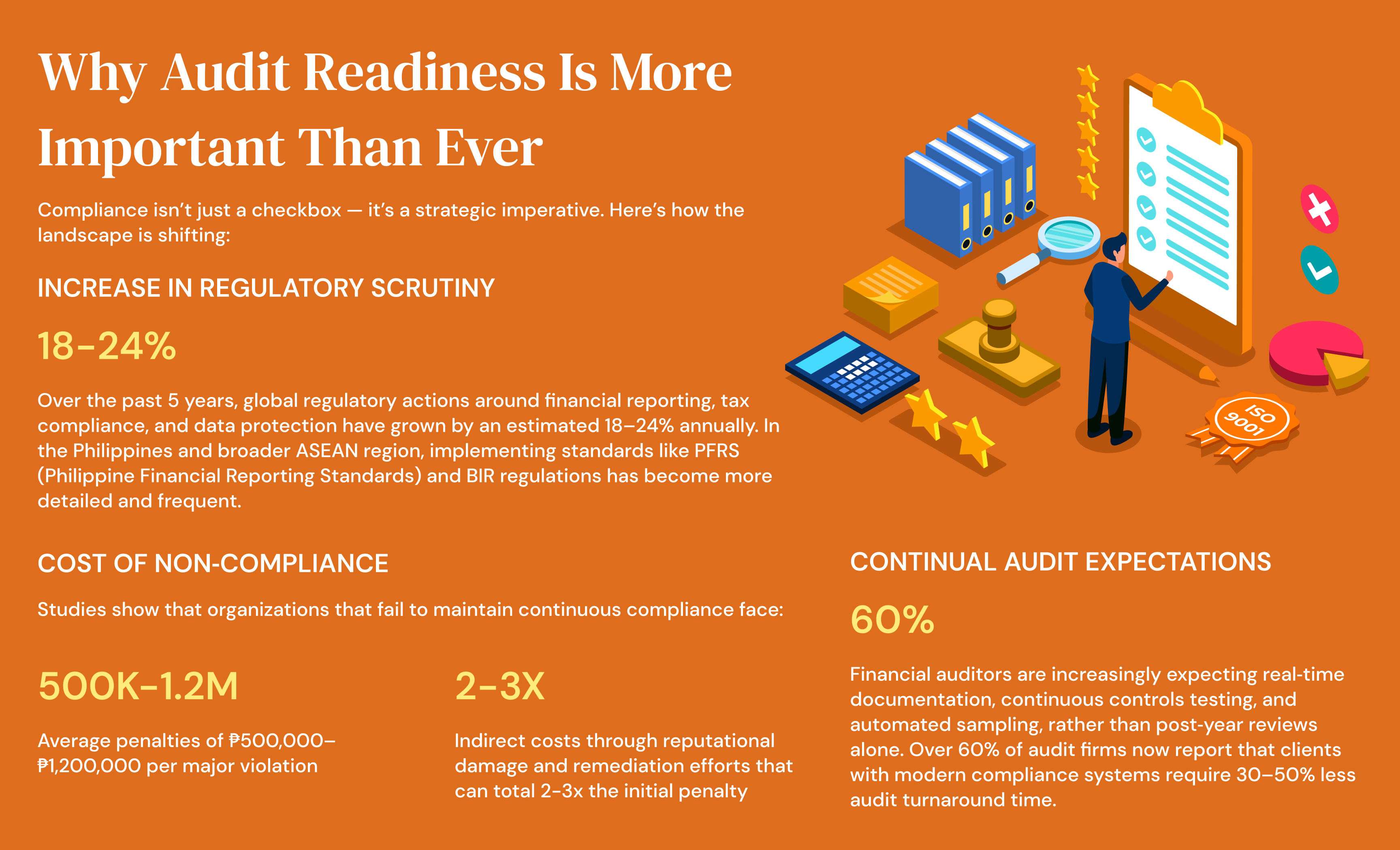
Early issue detection avoids fines and penalties — saving potentially ₱500,000+ per incident.
Stronger Internal Controls
Reduces fraud risk and operational inefficiencies.
Improved Financial Confidence
Stakeholders trust financials more when records are transparent and accurate.
Scalability & Growth
Compliant organizations attract investors and partners more easily.
Proactive compliance not only protects the business — it strengthens reputation and supports future growth.
Conclusion
The shift toward continuous compliance and audit readiness is no longer optional — it’s essential in a landscape of growing regulation and stakeholder demand for transparency. Organizations that embrace modern compliance best practices — from real‑time record keeping to automation and standardized procedures — are better equipped to withstand audits with confidence.