
Accounting is moving through a structural shift: the profession is becoming more technology-native, more real-time, more regulated (especially around sustainability and AI), and more advisory-led. Over the next five years, firms that modernize how they produce insights—not just reports—will be the ones clients keep. For organizations looking to stay future-ready, partners like XMC Asia can help translate these trends into practical systems, controls, and measurable performance gains.
Below are the trends most likely to shape accounting from now through the early 2030s—plus what they mean for clients, and how XMC Asia can position firms to win.
What Will Define the Next Five Years

AI becomes core infrastructure (not a “tool”)
AI is rapidly shifting from experimentation to embedded workflow infrastructure—supporting document review, reconciliations, drafting memos, risk spotting, and client communications. Industry reporting frames AI adoption as a strategic imperative, accelerating the move toward higher-value advisory work.
What it changes
- Faster close cycles and fewer manual touches (when data quality is strong)
- More time for scenario planning, cash-flow strategy, and margin analysis
- Higher expectations for governance: model controls, auditability, and human review
Where XMC Asia fits
XMC Asia can help firms operationalize AI responsibly—defining use cases, approval workflows, documentation standards, and review checkpoints so AI output is useful and defensible.

Real-time accounting and continuous close become normal
Cloud platforms and automation are pushing accounting toward near real-time reporting, where management decisions are driven by current data, not month-old snapshots. This “always-on” posture is increasingly paired with predictive capabilities for forecasting and planning.
What it changes
- Month-end fire drills shrink as work is distributed continuously
- Exceptions and anomalies get flagged earlier (before they become big problems)
- Client relationships become more proactive: “here’s what we see coming”
Where XMC Asia fits
XMC Asia can build a roadmap for continuous close, including process redesign, automation targets, and controls so speed doesn’t compromise accuracy.

ESG and sustainability assurance move from optional to expected
Sustainability reporting is increasingly shaped by regulation and global standards, and demand is rising for assurance over ESG information. IFAC has emphasized the need for global standards and connected reporting and assurance, and recent studies show growing global uptake of sustainability assurance practices.
What it changes
- More clients need help preparing ESG data that is auditable and decision-useful
- Accountants expand into sustainability reporting readiness and assurance support
- Stronger documentation, governance, and cross-functional data ownership
Where XMC Asia fits
XMC Asia can help clients design ESG data pipelines, define controls, and align reporting and assurance readiness with evolving requirements.

Audit and assurance become more data-driven—and more scrutinized
AI and automation can improve audit efficiency and coverage, but regulators are also pressing firms to measure and monitor AI’s impact on audit quality, not just usage.
What it changes
- More full-population testing and smarter risk targeting
- Greater pressure to prove quality outcomes, not just productivity
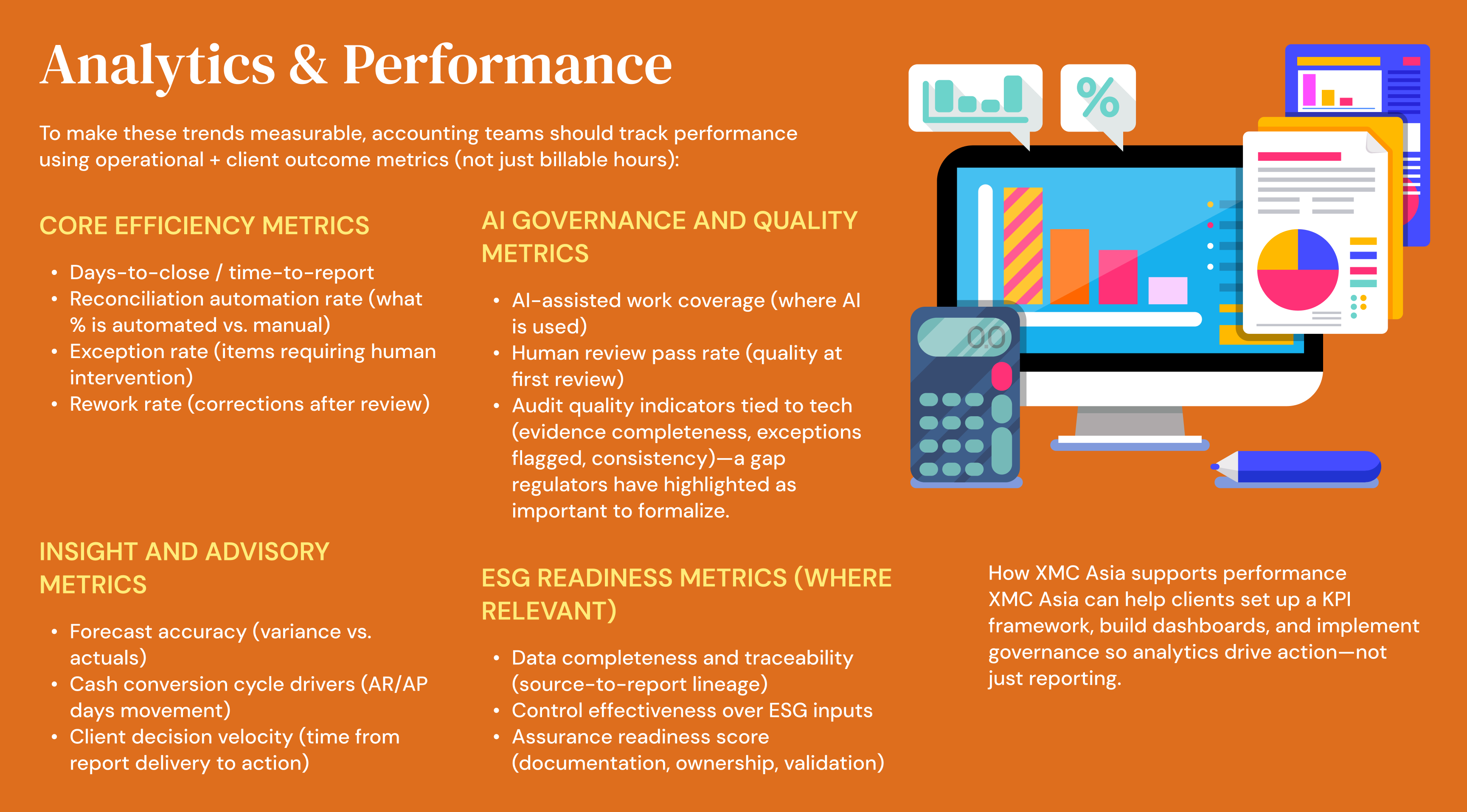
- Clear need for KPIs around accuracy, exceptions, and review effectiveness
Where XMC Asia fits
XMC Asia can help define audit-quality performance metrics and practical governance so technology adoption strengthens (not weakens) assurance.

The business model shifts toward advisory + specialization
With automation absorbing routine work, firms differentiate through industry specialization, value-based pricing, and advisory services—supported by technology-enabled delivery. AI’s rise is even influencing investment and consolidation strategies in accounting.
What it changes
- More bundled offerings: reporting + forecasting + KPI ops reviews
- Pricing shifts from hours to outcomes (speed, accuracy, insight, risk reduction)
- Advisory requires better data, clearer service definitions, and repeatable playbooks
Where XMC Asia fits
XMC Asia can help firms productize advisory services by standardizing dashboards, client review cadences, and KPI packs that are easy to deliver consistently.
Key Benefits
When firms align to these trends early, clients typically gain:
- Resilience and faster decisions: Real-time reporting and predictive insights reduce “surprise” outcomes and enable faster course correction.
- Lower operating friction: Automation cuts repetitive work (reconciliations, coding, document handling), improving cycle time and freeing capacity for advisory.
- Better risk control: Stronger governance around AI use, audit quality measurement, and documentation reduces regulatory and reputational exposure.
- New service lines: Sustainability reporting readiness and assurance-adjacent support create growth opportunities as demand rises.
- Higher client stickiness: When the firm delivers ongoing insight (not just compliance), relationships become strategic—harder to replace.
With XMC Asia, firms can pursue these benefits with a practical, phased approach—prioritizing high-impact workflows first, then scaling across teams and client segments.

Conclusion
Over the next five years, accounting winners will look less like “historical reporters” and more like real-time risk-and-performance partners. AI, continuous close, sustainability assurance, and stronger governance expectations are reshaping what clients value—and how firms prove value.
XMC Asia can help firms and finance teams modernize with confidence: designing workflows that are faster and smarter, while staying compliant, auditable, and performance-driven. The firms that invest now won’t just keep up—they’ll define what “modern accounting” means for their clients.
References