
ESG reporting is no longer a “nice-to-have.” It’s turning into a compliance and capital-markets requirement—driven by regulators (EU and certain US states), investors, lenders, and global baseline standards like ISSB (IFRS S1/S2). For accounting firms, the mandate isn’t just about producing a report; it’s about helping clients build audit-ready ESG data, controls, and governance that can survive scrutiny.
If you’re positioning services around this shift, XMC Asia can be positioned as a partner that helps clients move from ESG aspirations to assurance-ready reporting—with measurable readiness and defensible evidence.
What’s Actually Changing

EU CSRD is live—and still evolving
The Corporate Sustainability Reporting Directive (CSRD) has already started phasing in (first reports tied to FY2024, published in 2025, per the European Commission).
At the same time, the EU has recently moved to scale back and delay parts of its sustainability regime, including narrowing who is captured (per Reuters, February 24, 2026).
What firms should do: plan for CSRD readiness using the current requirements, but build flexibility into scoping and timelines because the regulatory perimeter is shifting.

ISSB is becoming the global baseline (and it’s spreading fast)
The IFRS Foundation is tracking jurisdiction-by-jurisdiction adoption progress.
By early 2026, multiple jurisdictions have adopted ISSB on a voluntary or mandatory basis, with reporting start dates spanning 2024–2026 in different markets.
For the Philippines specifically, an IFRS jurisdictional snapshot indicates a roadmap that endorsed adoption of IFRS S1 and IFRS S2 for periods beginning on/after January 1, 2025, subject to local regulatory issuance.
What firms should do: build capability around ISSB-aligned disclosures (governance, strategy, risk management, metrics/targets) because clients will increasingly be asked to map to these expectations—even when not strictly mandated.

The US is fragmented: federal uncertainty, state-level momentum
At the federal level, the SEC’s climate disclosure rule has faced significant uncertainty; in March 2025 the SEC voted to end its defense of the rule in litigation.
Meanwhile, state mandates—especially California’s climate disclosure laws—continue to move through rulemaking and timing guidance, with reporting expectations and deadlines being actively shaped (including updates into early 2026).
What firms should do: treat the US as a multi-regime environment—clients may still need climate disclosures due to lenders, customers, insurers, or state rules even if federal rules are delayed.
Key Benefits
When firms proactively help clients prepare for ESG reporting, the advantages are real and monetizable:
- Reduced compliance risk and rework: strong ESG data foundations prevent last-minute scrambles when a mandate applies or expands.
- Assurance readiness: building controls, traceability, and documentation early makes future assurance engagements feasible (and less painful).
- Better access to capital and procurement: clients increasingly face ESG requests from lenders, investors, and enterprise customers; readiness improves responsiveness and credibility (especially under ISSB-like expectations).
- New advisory revenue streams: ESG readiness expands the firm’s role into governance design, reporting architecture, and internal control buildout—adjacent to traditional assurance and risk work.
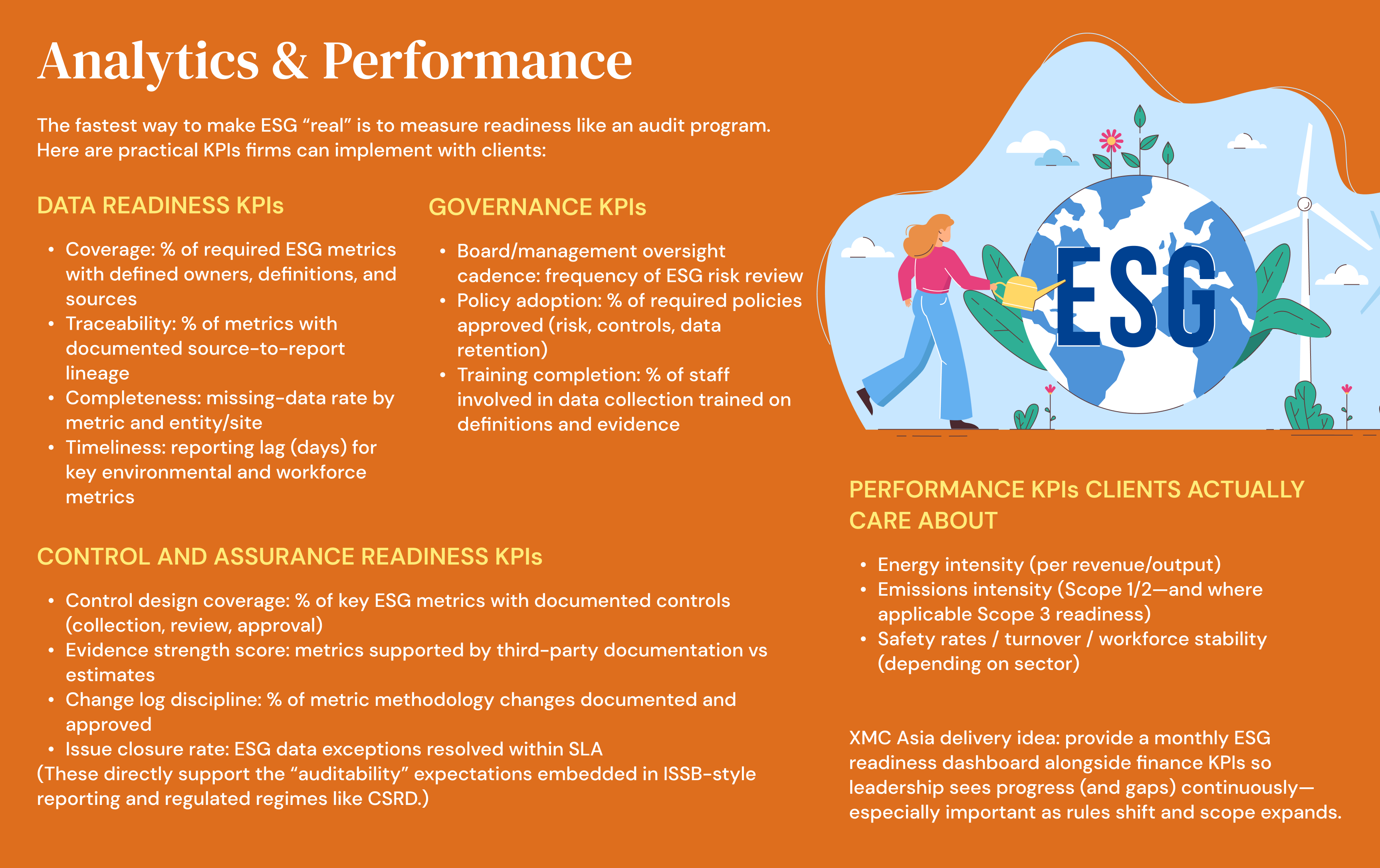
XMC Asia positioning: “ESG reporting readiness + controls + performance dashboards”—turning ESG into a structured finance-and-risk service line rather than a one-off reporting project.

Conclusion
The ESG reporting mandate is best understood as a multi-year operating change, not a one-time compliance exercise. Between the EU’s CSRD regime (and its ongoing recalibration), the rapid spread of ISSB as a global baseline, and the patchwork nature of US requirements, firms need a repeatable method to help clients:
- define scope,
- build ESG data pipelines,
- implement controls and evidence standards, and
- stay adaptable as mandates evolve.
Positioned correctly, this is a long-run growth opportunity for accounting firms. With XMC Asia, firms can package ESG readiness into a scalable service line that is measurable, defensible, and assurance-ready.
References
- European Commission — Corporate sustainability reporting (CSRD overview and timeline)
- IFRS Foundation — Jurisdictional profiles on ISSB adoption progress (June 2025)
- IFRS Foundation — Jurisdictional snapshot: Philippines (PDF)
- S&P Global — Where does the world stand on ISSB adoption? (Feb 2026)
- SEC — Press release: SEC votes to end defense of climate disclosure rules (Mar 27, 2025)
- PwC Viewpoint — California climate reporting (SB 253/SB 261) explainer (updated Jan 2026)