
In today’s fast-moving business environment, efficiency is no longer just “nice to have”—it is a competitive requirement. For accounting firms in 2025, automation has become the strongest driver of accuracy, productivity, and profitability. With rising client expectations, tighter reporting timelines, and increasing regulatory complexity, firms that continue to rely heavily on manual processes risk falling behind.
Forward-thinking companies—especially those partnering with outsourcing providers like XMC Asia—are using automation to transform their operations, reduce human error, and deliver faster, smarter financial services.
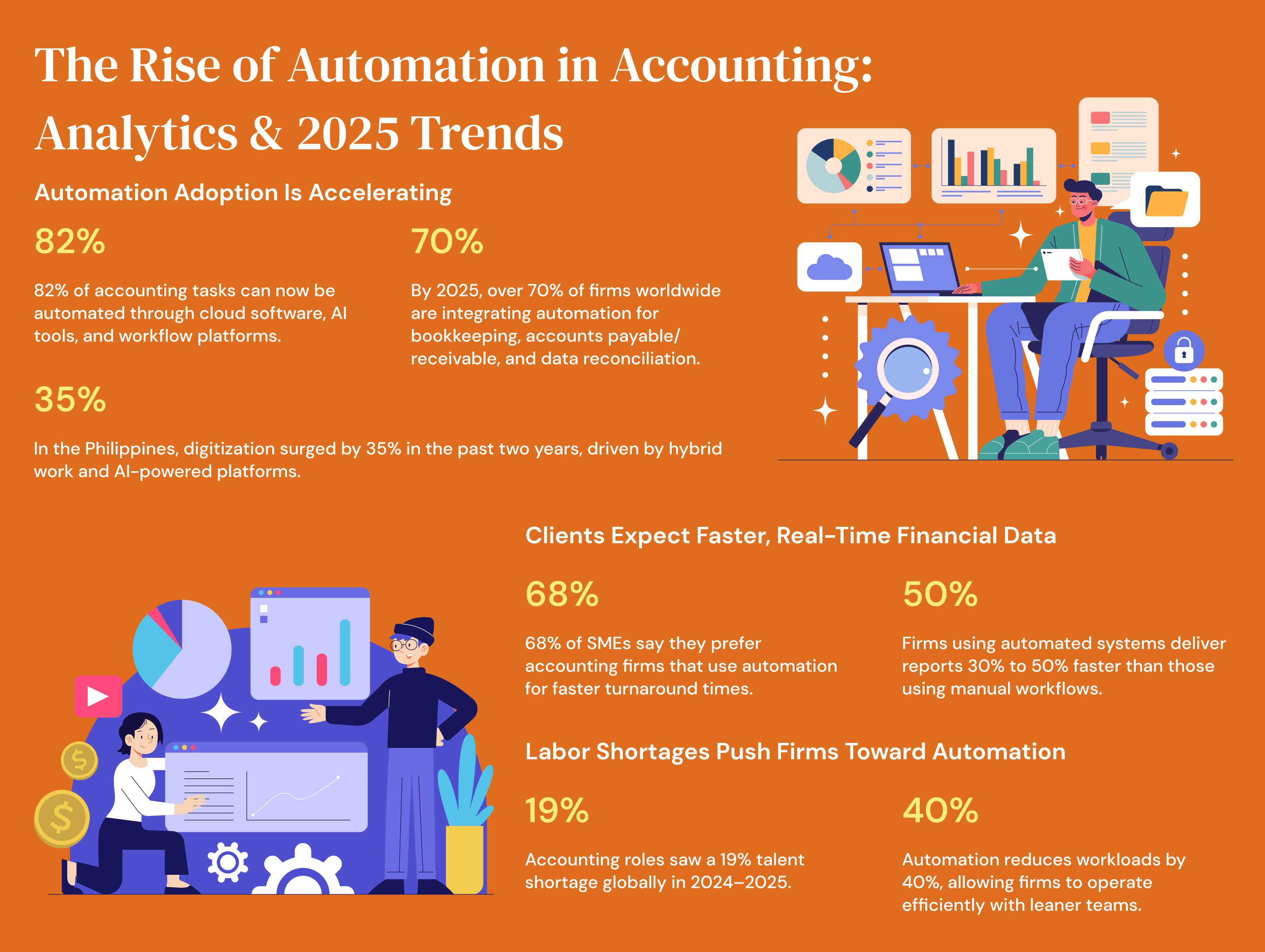

How Automation Gives Accounting Firms a Competitive Advantage

Greater Accuracy and Compliance
Manual encoding leads to human error—something highly risky in accounting. Automation provides:
- Up to 90% error reduction in data entry and reconciliation
- Better audit trails
- Automated compliance alerts for BIR and global reporting standards

Faster Turnaround and Real-Time Reporting
Clients now expect same-day updates, instant dashboards, and faster month-end closing. Automated workflows help firms achieve:
- 50% shorter month-end closing cycles
- Real-time visibility of cash flow, expenses, and ledgers
- Faster approvals and smoother audits

Lower Operational Costs
Automation reduces time spent on repetitive tasks and helps firms save significantly:
- Up to ₱300,000–₱1.2 million per year in labor costs
- Reduced cost of errors, rework, and delayed reporting
- More efficient use of senior accountants for higher-value tasks

Improved Client Satisfaction
Automation strengthens client trust through:
- Clear, accurate dashboards
- Timely updates
- More meaningful advisory services instead of repetitive admin work

Scalability Without Hiring More Staff
Firms powered by automation can handle more clients without proportional staff increases—an advantage especially for firms working with outsourcing partners like XMC Asia, who integrate both automation and skilled manpower.
Key Areas of Accounting Automation
Bookkeeping & General Ledger Management
AI tools automate entries, classifications, and reconciliations.
Accounts Payable & Receivable
Automated invoice processing saves firms 60–80% of processing time.
Payroll & HRIS Integration
End-to-end payroll automation reduces payroll errors by up to 85%.
Tax Preparation & Compliance
Trigger alerts ensure firms never miss BIR deadlines.
Financial Reporting
One-click reporting reduces preparation time from hours to minutes.
How XMC Asia Helps Accounting Firms Leverage Automation
XMC Asia combines advanced automation tools with expert accounting staff to give firms an edge through:
- End-to-end digitized accounting workflows
- Cloud-based bookkeeping and AI-powered data processing
- Automated AP/AR systems
- Real-time financial dashboards
- Scalable outsourced accounting teams trained in automation tools
This model helps firms cut costs, reduce workload, and deliver exceptional accuracy—allowing them to stay competitive in a fast-changing market.
Conclusion
Automation is no longer optional—it’s a strategic advantage that allows accounting firms to operate faster, smarter, and more cost-efficiently. With rising competition and evolving client expectations, firms that embrace automation can improve accuracy, enhance compliance, and unlock new levels of productivity.
As more firms adopt digital workflows and AI solutions in 2025, partnering with an automation-ready outsourcing provider like XMC Asia allows firms to scale operations, boost profitability, and stand out in a crowded industry.
References
- Oracle NetSuite. 12 Time-Saving Benefits of Automated Accounting
- AccountancyAge. AI, automation, and the new accountant: Trends shaping 2026
- Accountant Resource Center. 5 benefits of accounting automation for firms
- FinancialCents. 2025 Report: The State of Accounting Workflow And Automation
- Accounts Junction. How Accounting Automation is Transforming the Accounting Industry?