
As businesses expand into subsidiaries, branches, or international operations, financial complexity increases significantly. Multi-entity accounting becomes essential to maintain clarity, compliance, and decision-making accuracy across the entire organization.
For companies supported by operational and finance partners like XMC Asia, strong group reporting systems are a key driver of scalable financial governance.
What Is Multi-Entity Accounting?
Multi-entity accounting is the process of managing and consolidating financial data from multiple business units, subsidiaries, or legal entities into one unified reporting structure.
It ensures that:
- Each entity maintains accurate standalone books
- Group-level reporting reflects a consolidated financial position
- Intercompany transactions are properly eliminated
- Compliance is maintained across jurisdictions
In simple terms: it connects “many companies” into “one financial truth.”
Why Multi-Entity Accounting Gets Complicated
As organizations grow, reporting issues typically emerge from:
1. Different Accounting Systems
Each entity may use different tools, chart of accounts, or reporting formats.
2. Inconsistent Chart of Accounts (COA)
Without standardization, financial consolidation becomes error-prone.
3. Intercompany Transactions
Loans, service fees, and transfers between entities often get misrecorded or double-counted.
4. Currency Differences
Foreign exchange fluctuations complicate reporting accuracy.
5. Varying Compliance Requirements
Each jurisdiction may follow different tax and reporting rules.
Core Principles of Clean Group Reporting
1. Standardized Chart of Accounts
All entities should follow a unified COA structure to ensure consistency in reporting categories.
2. Centralized Reporting Framework
Data from all entities should flow into a single consolidation system or ERP.
3. Clear Intercompany Policies
Define rules for:
- Intercompany billing
- Cost allocation
- Loan tracking
- Eliminations
4. Monthly Closing Discipline
A strict close schedule ensures timely and accurate consolidation.
5. Audit-Ready Documentation
Every entity must maintain clear supporting documentation for all entries.
Key Benefits of Strong Multi-Entity Accounting

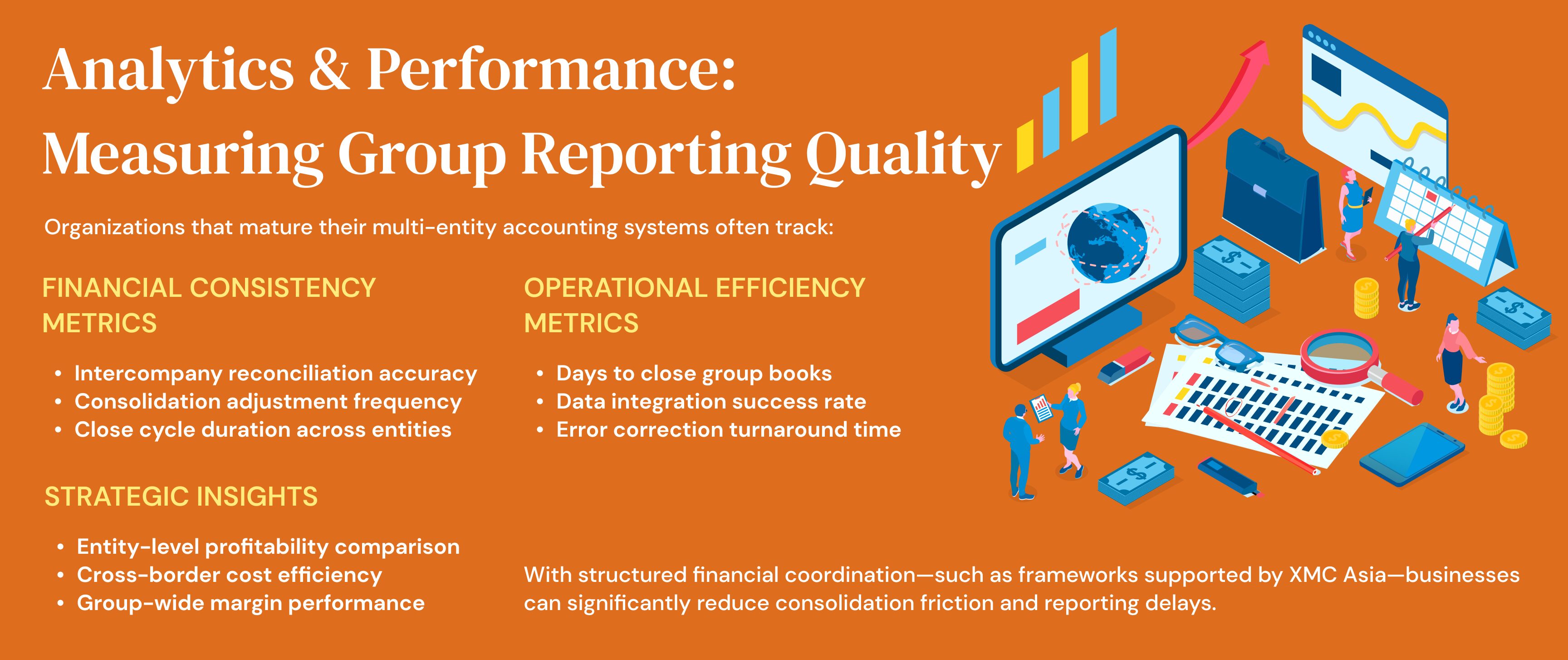
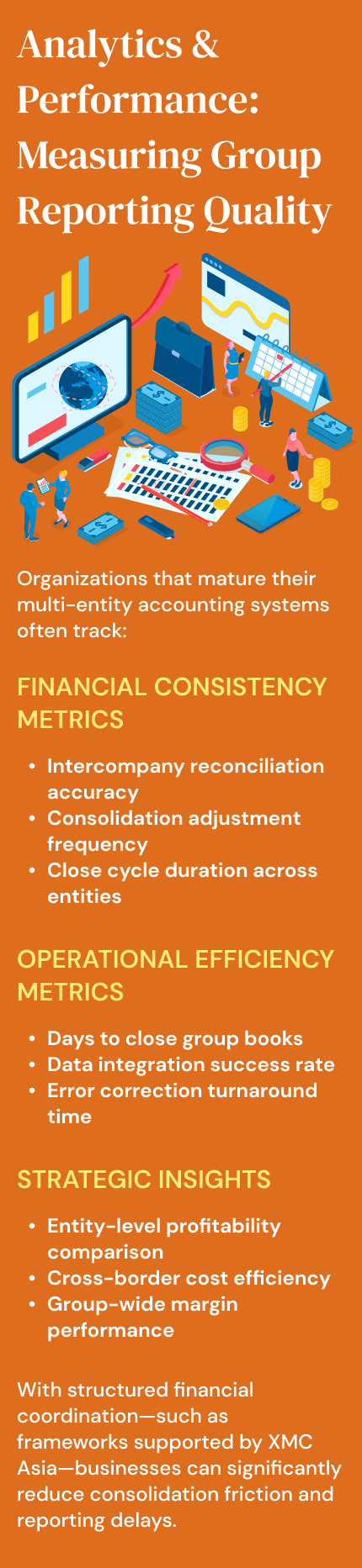
Accurate Group-Level Visibility
Executives gain a clear view of overall financial performance.

Faster Consolidation Process
Standardization reduces time spent on manual adjustments.

Improved Compliance
Ensures each entity meets local and international reporting standards.

Better Strategic Decision-Making
Leadership can compare performance across regions or subsidiaries.

Reduced Financial Risk
Minimizes errors, duplication, and misstatements across entities.
Best Practices for Scalable Multi-Entity Accounting
1. Use a Unified ERP System
Avoid fragmented tools that prevent real-time consolidation.
2. Automate Eliminations Where Possible
Reduce manual intercompany reconciliation errors.
3. Implement Entity-Level Controls
Each subsidiary should follow the same financial governance rules.
4. Align Reporting Calendars
All entities should close books on the same schedule.
5. Train Finance Teams Consistently
Standard procedures ensure uniform reporting quality across all units.
When Your Business Needs Multi-Entity Accounting Structure
You likely need a structured system if:
- You operate in multiple regions or countries
- You have subsidiaries or holding structures
- Intercompany transactions are increasing
- Consolidation takes too long or is error-prone
- Leadership lacks clear group-level visibility
At this stage, outsourcing or advisory support—such as that provided by XMC Asia—can help implement scalable financial architecture.
Conclusion
Multi-entity accounting is not just an accounting function—it is a financial control system for growing businesses.
When properly implemented, it ensures:
- Clean consolidation
- Reliable reporting
- Strong compliance
- Strategic financial clarity
For scaling organizations working with partners like XMC Asia, it becomes the foundation of sustainable financial governance across all business units.
References
- IFRS Foundation – Consolidation and Group Reporting Standards