
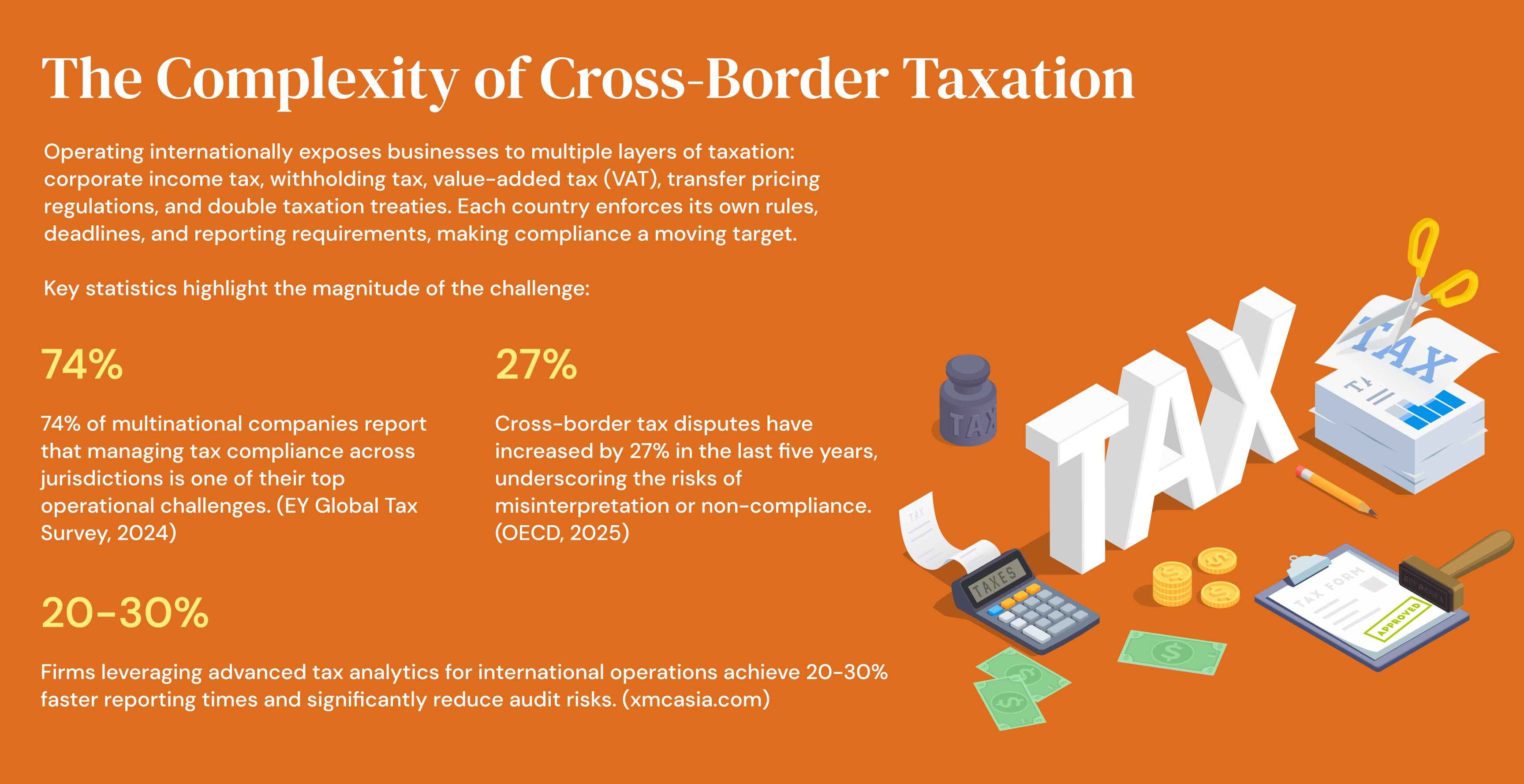
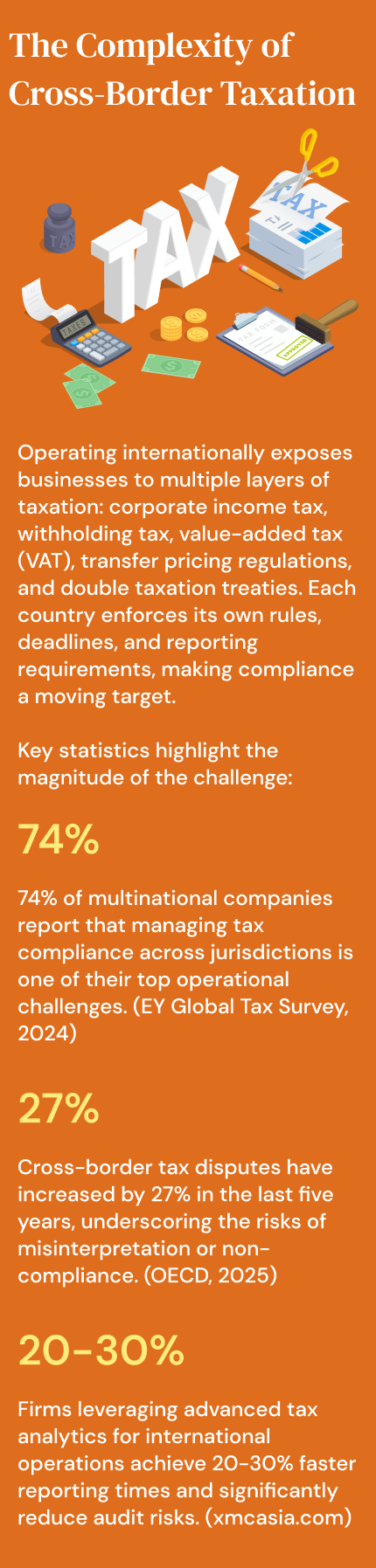
As globalization continues to accelerate, businesses are increasingly operating across borders. While international expansion presents significant growth opportunities, it also introduces complex tax challenges. Multinational operations require careful planning to comply with diverse tax jurisdictions, optimize costs, and avoid penalties. Forward-looking firms like XMC Asia are helping businesses navigate these complexities with tailored strategies and technology-driven solutions.
Key Challenges in Cross-Border Tax Management

Transfer Pricing Compliance
Multinational businesses must ensure that intercompany transactions are priced at “arm’s length” to satisfy regulatory authorities. Mispricing can lead to significant penalties.

Double Taxation Risks
Without careful planning, companies may pay taxes in multiple jurisdictions on the same income. Understanding treaties and exemptions is critical.

Regulatory Variability
Each country updates tax regulations regularly. Firms must track changes to avoid errors and optimize tax positions.

Currency and Reporting Issues
Converting local financials into a consistent reporting currency and meeting diverse reporting standards adds another layer of complexity.
How Firms Can Stay Ahead
Engage Expert Cross-Border Advisory
Partnering with firms like XMC Asia provides businesses with deep knowledge of local and international tax laws, ensuring compliance while minimizing tax liability.
Leverage Technology and Analytics
Cloud-based accounting systems and AI-driven tax analytics allow firms to monitor obligations in real-time, detect discrepancies, and automate reporting.
Scenario Planning and Forecasting
Using predictive analytics, businesses can simulate different tax scenarios, evaluate the impact of policy changes, and optimize operations accordingly.
Continuous Education and Compliance Updates
Regular training and staying updated with tax law changes ensure that internal teams and advisors can respond quickly to new regulations.
Key Benefits of Effective Cross-Border Tax Management
| Benefit | Impact on Business |
|---|---|
Regulatory Compliance |
Reduces risk of penalties and audits |
Optimized Tax Burden |
Maximizes after-tax profits |
Strategic Decision Support |
Informs expansion and investment decisions |
Enhanced Reputation |
Builds credibility with stakeholders and investors |
Operational Efficiency |
Streamlines reporting and accounting processes |
Analytics and Insights
According to global research:
- Businesses using AI-driven cross-border tax tools report up to 40% reduction in manual processing errors.
- Firms that proactively monitor international tax changes experience 30% faster response times to audits and inquiries.
- Strategic tax advisory increases client satisfaction and strengthens long-term partnerships, particularly when paired with real-time reporting and scenario planning.
Conclusion
Cross-border taxation is a complex but navigable landscape. Businesses that invest in expertise, technology, and proactive compliance strategies not only mitigate risks but also create strategic advantages in a global market. By partnering with firms like XMC Asia, companies can transform cross-border tax management from a compliance burden into a value-generating function.
In a globalized economy, staying ahead of tax challenges is no longer optional—it is essential for sustainable growth and competitive advantage.
References