
As businesses scale, one of the most important financial decisions is whether to build an in-house accounting team or outsource accounting functions. This choice directly affects cost structure, operational efficiency, compliance risk, and long-term financial scalability.
For growing companies working with structured finance partners like XMC Asia, this decision is often a turning point in building a scalable and efficient finance function.
Understanding the Two Models

In-House Accounting
An in-house accounting team consists of full-time employees responsible for managing all financial processes internally, including bookkeeping, reporting, compliance, and analysis.
This model gives businesses:
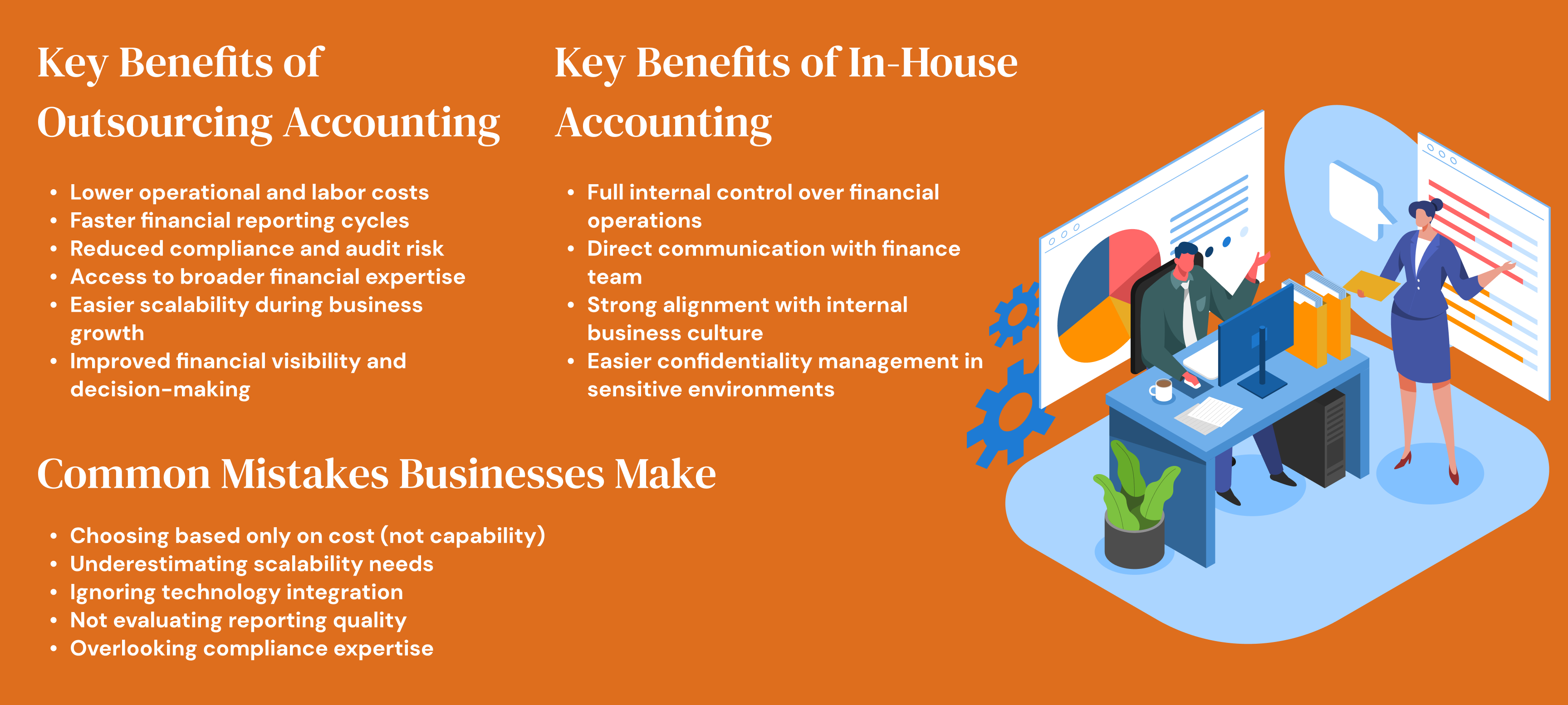
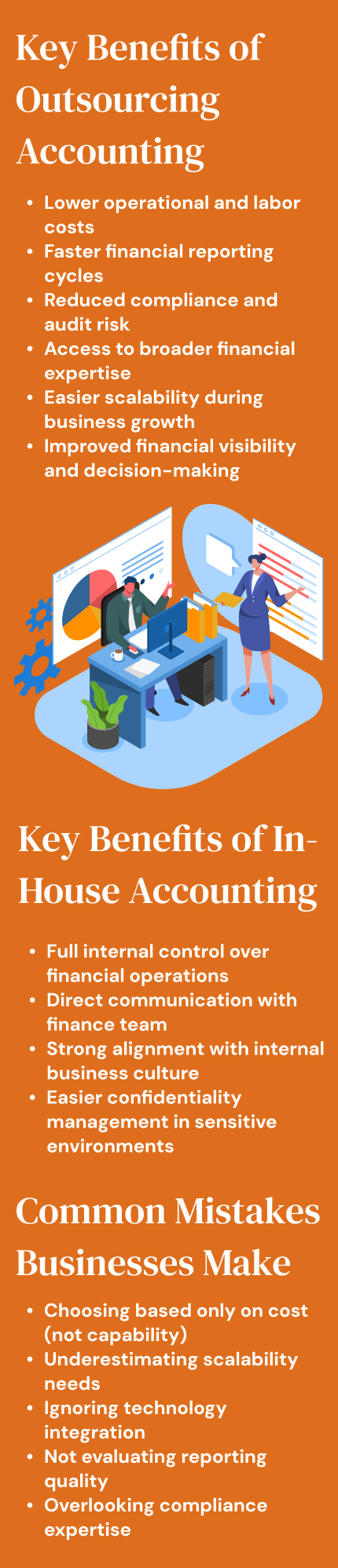
- Full internal control
- Immediate access to financial staff
- Direct alignment with company culture
However, it also requires:
- Higher fixed costs
- Recruitment and training investment
- Ongoing management and oversight

Outsourced Accounting
Outsourced accounting involves partnering with an external provider to handle financial processes such as bookkeeping, reporting, payroll, tax preparation, and financial analysis.
This model offers:
- Access to specialized expertise
- Flexible scaling
- Reduced operational burden
- Advanced tools and systems without internal investment
Cost Comparison
In-House Accounting Costs
Hiring an internal team involves multiple cost layers:
- Salaries and wages
- Employee benefits (healthcare, bonuses, etc.)
- Recruitment and onboarding costs
- Software and accounting system licenses
- Training and development
- Office space and infrastructure
As the business grows, costs increase linearly or even exponentially due to additional headcount requirements.
Outsourced Accounting Costs
Outsourcing typically operates on a fixed or usage-based pricing model.
Costs usually include:
- Monthly service fees
- Scope-based packages (bookkeeping, reporting, CFO support)
- Optional add-ons (tax, advisory, multi-entity support)
Unlike in-house teams, outsourcing converts fixed costs into predictable operational expenses.
Risk Comparison
In-House Accounting Risks
- Key person dependency (risk if staff leave)
- Limited expertise in specialized areas (tax, compliance, multi-entity reporting)
- Higher chance of manual errors in small teams
- Scalability constraints during rapid growth
Outsourced Accounting Risks
- Dependence on external provider quality
- Potential communication delays if not well-structured
- Less immediate physical oversight
However, reputable providers reduce these risks through:
- Standardized processes
- Multi-layer review systems
- Automation and cloud-based tools
- Dedicated account management structures
For example, structured finance service models like those supported by XMC Asia typically emphasize process consistency and compliance-driven workflows to minimize operational risk.
ROI Comparison
ROI of In-House Accounting
In-house teams deliver value through:
- Strong internal alignment
- Direct control over financial data
- Institutional knowledge retention
However, ROI can be limited when:
- Teams are overworked or under-skilled
- Systems are outdated
- Scaling requires constant hiring
ROI of Outsourced Accounting
Outsourcing often delivers higher ROI due to:
- Lower total cost of ownership
- Access to experienced professionals across multiple domains
- Built-in scalability without hiring delays
- Improved reporting accuracy and speed
- Reduced financial errors and compliance risks
Businesses often see ROI improvements in:
- Faster month-end closing cycles
- Better cash flow visibility
- Reduced audit adjustments
- Improved decision-making speed
Side-by-Side Comparison
| Factor | In-House Accounting | Outsourced Accounting |
|---|---|---|
Cost Structure |
Fixed (high overhead) |
Flexible (service-based) |
Scalability |
Slow (requires hiring) |
Fast (instant scaling) |
Expertise |
Limited to team skills |
Broad, specialized expertise |
Risk Level |
Key person dependency |
Process-based risk distribution |
Technology |
Requires internal investment |
Included in service model |
Control |
High |
Moderate (shared with provider) |
Reporting Speed |
Varies by team size |
Typically faster and standardized |
Strategic Considerations for Growing Businesses
When In-House Accounting Makes Sense
- Large enterprises with stable operations
- Highly regulated industries requiring internal oversight
- Companies needing constant on-site finance collaboration
When Outsourcing Is the Better Fit
- Fast-growing SMEs
- Multi-entity or multi-location businesses
- Companies needing rapid financial scalability
- Organizations optimizing for cost efficiency
Role of Structured Finance Partners (e.g., XMC Asia)
For scaling businesses, structured finance partners like XMC Asia often bridge the gap between basic accounting and full financial operations by offering:
- Standardized accounting workflows
- Scalable reporting systems
- Multi-entity financial consolidation
- Compliance-ready documentation
- Integrated financial analytics
This allows businesses to operate with enterprise-level finance capability without building large internal teams.
Conclusion
The decision between outsourcing accounting and building an in-house team is not just financial—it is strategic.
- In-house accounting offers control but comes with higher fixed costs and scalability limitations.
- Outsourced accounting offers flexibility, efficiency, and access to broader expertise.
For growing companies, especially those working with structured finance partners like XMC Asia, outsourcing often provides a more scalable, cost-efficient, and future-ready financial model.
Ultimately, the best choice depends on your business size, growth trajectory, and need for financial agility.