
Sustainable finance is no longer “nice to have.” It’s becoming how capital gets priced—through climate risk, transition plans, supply-chain exposure, and verifiable ESG data that investors and regulators can trust. Accountants sit at the center of this shift because sustainable finance ultimately runs on the same thing traditional finance runs on: reliable numbers, consistent controls, and decision-useful disclosures.
Firms like XMC Asia can help clients translate sustainability ambition into audit-ready, investor-ready reporting—without turning ESG into a disconnected side project.
Key Benefits

Turning sustainability into decision-useful disclosures
Sustainability reporting is increasingly tied to financial statements and capital allocation. IFRS Sustainability Disclosure Standards (IFRS S1 and IFRS S2) are designed to provide sustainability-related financial disclosures and climate-related disclosures for users of general-purpose financial reports.
What accountants do (practically):
- connect sustainability risks/opportunities to financial impacts (revenue, costs, impairments, provisions)
- align reporting timelines so sustainability information can be issued alongside financial reporting
- standardize disclosures so they’re consistent period-to-period

Building the data backbone (controls, audit trail, and governance)
Sustainable finance relies on credible underlying data—energy usage, emissions, supplier information, workforce metrics, and more. Accountants are the natural owners of:
- data definitions and boundaries (what’s included/excluded)
- internal controls over data collection and calculation
- documentation that supports assurance and reduces greenwashing risk
This matters more as assurance expectations rise, including the global sustainability assurance standard ISSA 5000.

Helping clients navigate overlapping frameworks (ISSB, ESRS, GRI)
Many organizations face multiple frameworks:
- ISSB (IFRS S1/S2) for investor-focused sustainability-related financial disclosures
- EU CSRD / ESRS requirements for entities in scope of EU reporting
- GRI Standards for impact reporting across economy, environment, and people
Accountants (and XMC Asia) can map these requirements to a single “source of truth” dataset, preventing duplicated work and inconsistent numbers.

Improving access to capital and reducing financing friction
Banks and investors increasingly expect structured climate/sustainability information. The TCFD framework (governance, strategy, risk management, metrics/targets) has been widely adopted and is now often a bridge toward ISSB-aligned reporting.
When accounting teams build disciplined sustainability reporting, clients can:
- respond faster to lender/investor requests
- reduce diligence friction
- strengthen credibility in sustainability-linked financing conversations

Staying ahead of fast-changing regulation (especially in the EU)
Sustainability rules in Europe have been evolving rapidly. Notably, in late February 2026, the EU finalized a “Sustainability Omnibus” / simplification package that scales back parts of the sustainability reporting and due diligence regime, including narrowing CSRD scope (thresholds reported as >1,000 employees and €450m turnover in coverage of the changes).
For clients with EU operations (or EU-linked supply chains), accountants help interpret what changed—and what still must be reported—without losing momentum on governance and data quality.
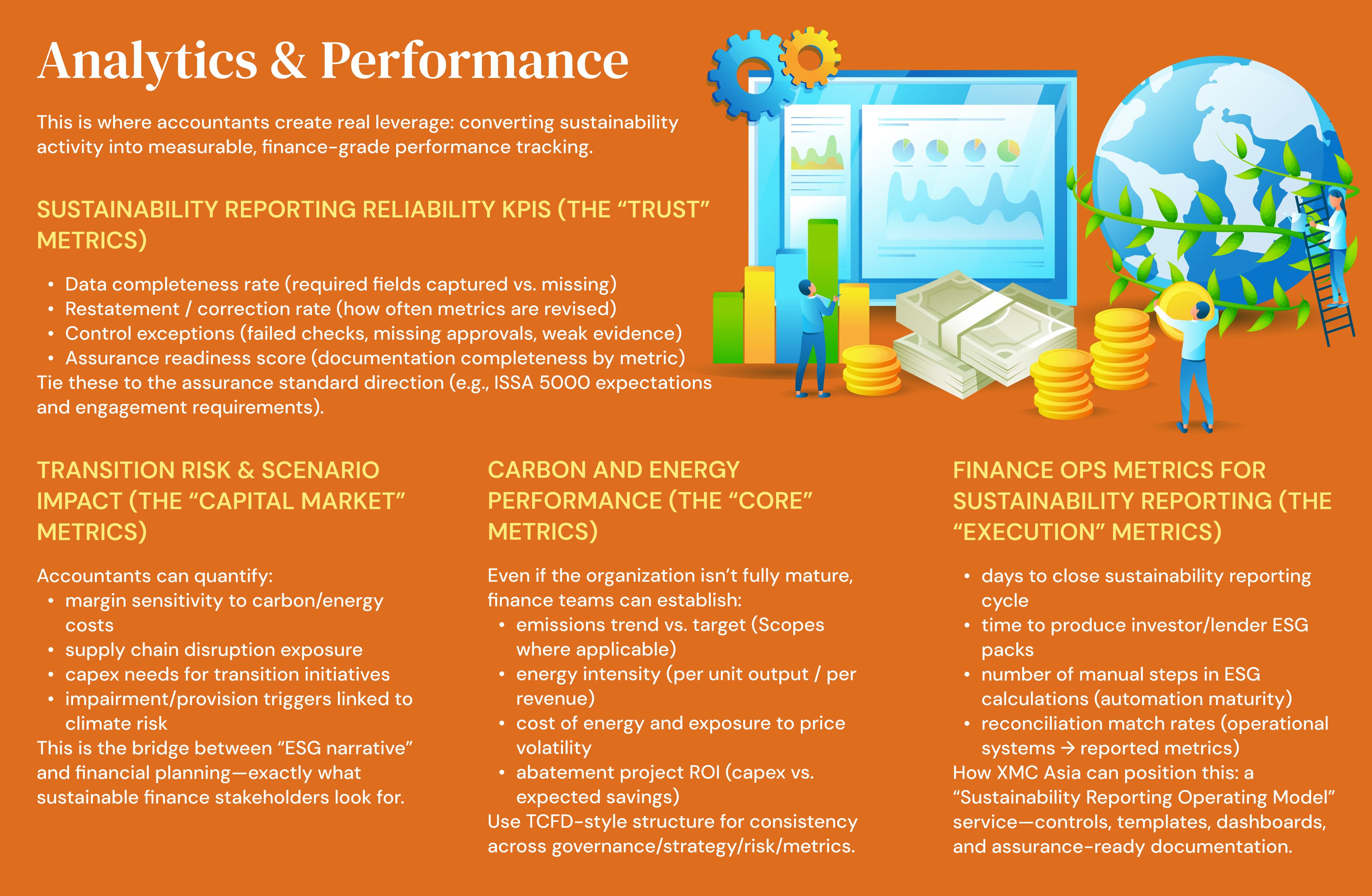

Conclusion
A greener economy needs more than pledges—it needs credible information that markets can price and stakeholders can trust. Accountants make sustainable finance real by building the measurement system: consistent definitions, reliable controls, decision-useful disclosures, and assurance readiness.
For clients navigating today’s shifting standards and regulations, XMC Asia can play a pivotal role—helping organizations integrate sustainability into finance operations so reporting is credible, comparable, and resilient under scrutiny.
References